Search This Blog

Showing posts with label Ritchie Blackmore. Show all posts

Thursday, May 7, 2015

Blackmore's Night - Shadow of the Moon


I have written before about how the older someone gets the more mellow they become and we see this happening to effectively every musician who has ever lived. Ritchie Blackmore is no exception to this rule. He went from being the most memorable member of a classic rock band often credited for laying the ground work for heavy metal and now... well now he is doing something completely different.

In 1994, approximately, Ritchie Blackmore left Deep Purple, this time for good. In 1997 Blackmore with his then fiancée Candice Knight formed the aptly named two piece band Blackmore’s Night. This new band and new direction by Blackmore is completely different from everything he had created previously. Blackmore’s style mellowed dramatically, and under the banner of Blackmore’s Night he took to writing festival like folk music along with a variety of guitar focused cover songs both from classic rock and old classical music. It was like he traveled backward in time, like five hundred years, and got in touch with his inner minstrel. This change was unprecedented, and it has left many loyal Blackmore fans surprised and saddened. They do not want Blackmore to play at renaissance fairs (no really that is what Blackmore is doing now) they want him to play classic Deep Purple and Rainbow songs.

I too love Deep Purple and Rainbow, I too want Ritchie Blackmore to play “Child In Time” and “Stargazer,” but I also love Ritchie Blackmore and I want him to be happy, so I am perfectly okay with him playing classic guitar and classic inspired guitar music with his wife at renaissance fairs. It helps that Blackmore’s Night is also really good.

As a young person, Candice Knight was a huge fan of Rainbow, and she met Ritchie at a signing event, or something like that, and they got to a talking and realized they had a lot of common interests and became friends. For a short time Candice did backing vocals for Deep Purple but by 1994 Ritchie left the band, this time for good, and took his then fiancée with him.

They look happy to me.
Candice Knight is very pretty and I mistook her for a model, partially because she as a glow about her that would have made her a successful model if she had chosen that career, but also partially because it is a classic outcome for a rock stars to marry supermodels. For me there was an immediate concern seeing just how pretty and young Candice was, she is twenty-six years younger than Ritchie and naturally my first fear was that Ritchie was going to lose half of his stuff. However it does not appear that way at all, not only do they seem legitimately happy together, but they have now been together for two decades or more. Furthermore they share music, the single biggest aspect of both of their lives and that must be a beautiful connection to share with someone you love. So hurrah some stories have happy endings.

This is normally where I bring up a specific song to talk about, because I know the attention span on the average person these days struggle with a whole band or even album, but I found it incredibly hard to pick just one song by Blackmore’s Night. As of today Blackmore’s Night has released nine studio albums, which yields a lot of material to listen to and enjoy, which also leaves me with a lot of options to choose from. So somewhat randomly I am going to talk about “Shadow of the Moon.”

“Shadow of the Moon” is the title track off of their first album, released in 1997, so it seems a good a place to start as any for a dialogue about Blackmore’s Night.

One thing I like about “Shadow of the Moon” is it reminds me a little “Green Sleeves” the old English folk song, but I hear that song everywhere, possibly because it is one of the first songs I learned to play moderately well on guitar. Naturally Blackmore’s Night also does a cover of “Green Sleeves,” of course they do, that’s their thing. The folk styling of old medieval is a constant theme throughout Blackmore’s Night entire body of work and the charm that offers is present also in “Shadow of the Moon.” I really appreciate now Blackmore and Knight are able to create so many songs that sound like the style of the past. I am constantly forced to look up their songs to see if they are old songs I am unfamiliar with, sometimes they are, but mostly they are original tracks either composed of various past inspirations or completely new pieces of work. Every time I discover another song that sounds like it came from Camelot and it was created in the modern time I am impressed with just how in tune with this style Blackmore and Knight have become.

While the original work is definitely the most impressive content by Blackmore’s Knight I am very fond of their cover of Bob Dylan’s “The Times They are a Changing,”

The Time They Are a Chagin

That music for “The Times They are a Changing” in particular really captures what I really like about Blackmore’s Night, Ritchie and Candice seem so damn happy. Ritchie has always been a very relaxed individual, never seeming to get to excited, but seeing him jamming out with a very happy blonde angel with a super nice smile makes me all feel warm inside. It seems like they are really happy.

So If you still feel sad that Blackmore is not playing “Child In Time” anymore, check out this live performance:

Child In Time - Live

"Sisters of the moon," hippier words have never been spoken.

What was that? A French horn? The point is you might get to hear “Child In Time” or some other Deep Purple or Rainbow classic at a renaissance fair, or some other medieval theme festival, someday. I have to say, think we have a winner in Blackmore’s Night.

- King of Braves

Saturday, April 18, 2015

Rainbow - Stargazer


In 1975 Ritchie Blackmore left Deep Purple, at least for a while. Blackmore was temporarily replaced by Tommy Bolin but by March of 1976 the band split up, and I have to suspect the primary reason had something to with Blackmore not being there anymore. The only original members by that time were drummer Ian Paice and Jon Lord on keyboard. Thus began the nine year hiatus where Deep Purple did not exists, allowing Blackmore, Lord and Paice to lend their skills elsewhere, in solo acts and other bands. Blackmore, the main man of the hour, formed the band Rainbow with his friend Ronnie James Dio.

Deep Purple has experience massive turnover over the years but Rainbow is an even more chaotic lineup of changes in a much smaller period of time with the only constant factor being Mr. Blackmore himself. However it is clear that Ritchie Blackmore is Rainbow. It is his project, so everything fits just fine. However most people remember the first three albums most fondly, and part of that I suspect has to do with Dio’s presence.

Before Rainbow Dio was the front man for a band named Elf, and that name alone pretty much tells you everything you need to know about Dio (originally the band was named The Electric Elves). Ronnie was big into fantasy and rock and roll, it could be argued that he was the original power metal front man and because of this he has endeared himself to many.

Dio & Blackmore
Blackmore a somewhat underappreciated guitar legend and Dio a somewhat ineffectual but lovable front man both offer a special something, and when combining their talents we did get something special, something like fantasy, we got power metal. Rainbow is a high point for both men in their legendary careers.

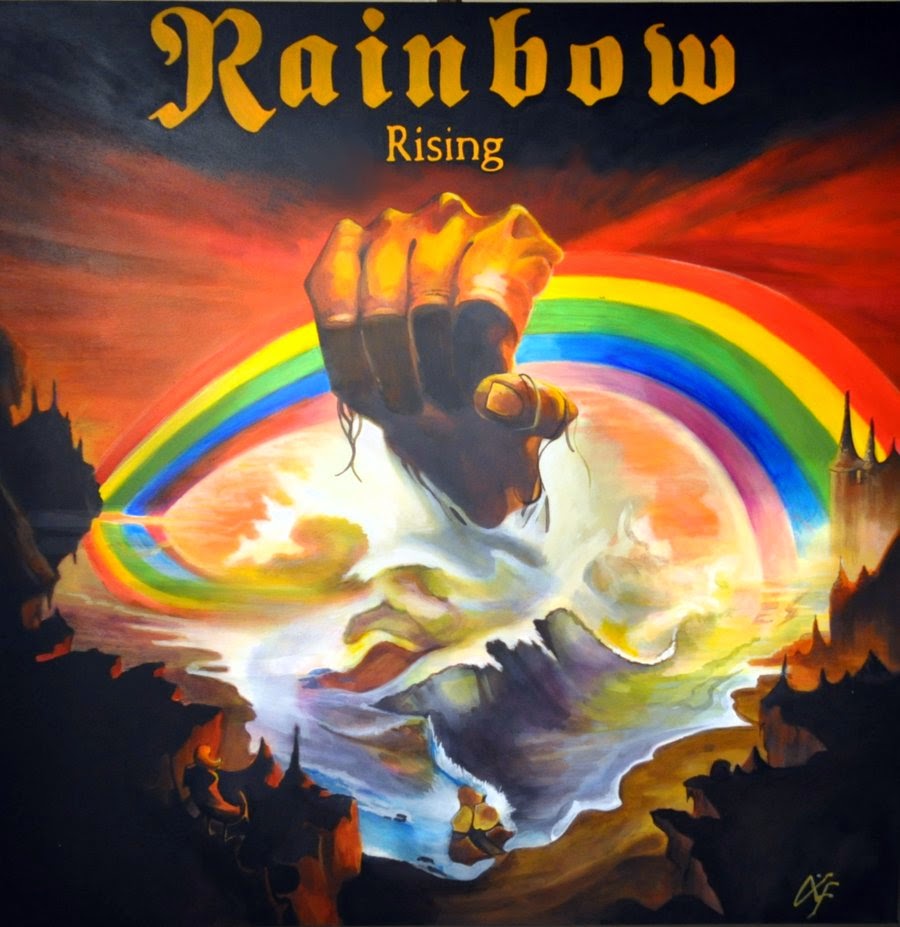
It was on Rainbow’s second album “Rising” where my favorite Rainbow track resides, “Stargazer.” There is a variety of reasons why a song like “Stargazer” appeals to my likings. I have always loved long epic rock songs that take us on an adventure and “Stargazer” at eight and a half minutes accomplishes this. Also it tells a story about the failure of religion, and that is something I can always get behind.

The lyrics introduce a community of people building a tower for their messiah so he can fly off and reach the stars. The horrors of this blind devotions are presented from the perspective of a believer and with that Dio emotes a passion for the hopeless project, casually brushing off, or perhaps even lovingly embracing the grim sacrifices these people have to make for their beliefs, in fact every verse builds upon this suffering:

“High noon, oh, I'd sell my soul for water,
Nine years' worth of breaking my back.
There's no sun in the shadow of the wizard.
See how he glides, why he's lighter than air.”

And;

“Hot wind moving fast across the desert.
We feel that our time has arrived.
The world spins while we put his wing together.
A tower of stone to take him straight to the sky.”

And also;

“But why? It don't rain with all our chains,
Did so many die, just to see him fly.
Look at my flesh and bone.
Now look, look, look, look, look at this tower of stone.”

By the final verse it has been revealed that the “wizard” was a false prophet as “he falls instead of rising” once atop the tower. These verses show us that not only are these people desperate, dying of thirst, but they are literal slaves to the construction of this pointless holy tower. However we do get a small silver lining at the end, after the wizard has fallen and died, a rainbow, how appropriate, can be seen on the horizon;

“I see a rainbow rising, look there on the horizon,
And I'm coming home, coming home, I'm coming home.

Time is standing still, he gave me back my will,
Oh, oh, oh, oh, going home, I'm going home.
My eyes are bleeding and my heart is weeping,
We still hope, we still hope, oh.”

Weird but lovable Dio
It is a dark story but freedom and release is accomplished by the end. This fictional narrative is realistic insofar that it likely takes a disastrous event for the blind faithful to realize the torture of their chains either physical or psychological. It is a message that has become well communicated to the world at large but is a message worth repeating indefinitely and in 1976 this was probably a very unpopular message. There is presumably some degree of courage by Blackmore and Dio to so abrasively release this song at the time, but they were not alone, Black Sabbath’s “Sabbath Bloody Sabbath” has similar sentiments but still they were clearly progressive in this manner of thinking. Nonetheless I feel “Stargazer” is not just a really great song in Ritchie Blackmore’s history but I feel it also captures the best of Dio. As I stated Dio was never the most effect front man, but he had a charisma about, and he had a good heart and wild imagination and I think we see all of that on display in “Stargazer.” It is a song that is both fantastic and political, it may have certain level of magic in it, but at the same time is a sincere plea to reason, and I feel that is what Dio was all about.

Until next month keep on rocking in the free world.

- King of Braves

Ironically most of the images of the band Rainbow are in black and white.

Friday, April 10, 2015

Deep Purple - Child In Time


Looking backwards Deep Purple was a troubled band. Most bands don’t have four lead singers, four lead guitarist, three bass players and two keyboard players over its history. Most bands never have an issue maintaining a consistent front man in the role of lead singer or lead guitar, most bands dissolve when the theoretical leadership roles experience routine turnover (lead guitarist Ritchie Blackmore was present for all the most significant moments in the band’s history). Most bands do not cease to exist for a decade (between 1976 and 1985). Most bands would be unable to produce nineteen studio albums with all of these difficulties confronting them.

Despite plenty of critic appeal and a fine stable of radio hits Deep Purple is rarely mentioned among the all time greats of classic rock and have yet to be inducted into the rock and roll hall of fame.

What’s up with that?

I wonder if the constant change over of lead singers and the large gap of time where Deep Purple did not exist or if any of the other inconsistencies in their line up and presence may have harmed Deep Purple in some culturally successful way. They are kind of a funny band in that way, Deep Purple is just on the fringe of being considered one of the all time best bands of all time in the minds of most, yet they are also similar to other cult rock and roll bands who have a devout following and are largely ignored by the mainstream. They act more like a cult band, constantly touring and making music regardless of sales of approval. I wonder if Deep Purple is the most successful cult band that remained a cult band, or if they are a successful band that is to some degree taken for granted.

Now for an anecdote:

Many moons ago I was working the kitchens and my co-worker asked me if I had any classic rock on my MP3 player, of course I did, who the hell do you think I am? He asked me what I had so I listed off the greats, Zeppelin, Floyd, Who, Beatles, etc.

“What about Deep Purple?”

I had like four songs by Deep Purple. The four you would mostly often hear on the radio, “Smoke on the Water,” “Space Trucking,” “Highway Star,” and “My Woman from Tokyo,” I might have had “Hush” as a fifth. My co-worker was unimpressed. He counted Deep Purple among the greats and I had a meager number of songs to show for them on my personal collection. I did not even have “Child In Time.”

The first major track to force a reinvestment of my attention in Deep Purple was “Child In Time,” a song you will probably never hear on the radio but was from most peoples’ perspectives the first truly great Deep Purple song. The first three albums Deep Purple released were consumed with cover songs, and it was not until their fourth album “Deep Purple In Rock” (1970) did the band finally release an album that was comprised entirely of original material. As a result “Child In Time” is often cited by critics as the turning point for Deep Purple, Roger Glover was now on Bass and would be forever thereafter, all tracks were original, and frankly most people would agree that “Deep Purple In rock” was the best album produced by the band thus far at that time, and may would agree hence forth thereafter.

“Child In Time” is a perfect example of the experimental style of 1970. It is a ten minute odyssey full of daring new approaches to sounds creation and presentation. The sound of “Child In Time” fits right in with Emerson Lake and Palmer, or The Moody Blues “Beyond a Threshold of Dream” which came out the year prior. Progressive rock advanced yet another step forward thanks to Deep Purple and “Child In Time” and as such many Deep Purple fans recall it as the epoch of all men involved careers.

The popularity surrounding “Child in Time” is not dissimilar to Aerosmith’s “Dream On.” Many hardcore fans would point to the early masterpiece of both bands careers as being their finest work, but most people are either unfamiliar with or less familiar with those songs as they are with the radio hits, the more conventionally popular. In “Child In Time’s” case the length alone made it taboo for radio play and thus missed entirely by a significant, and disappoint, number of people.

Everyone knows, or at least should know, that Ritchie Blackmore is a fantastic guitarist, and I really like the dropping rhythm that carries the verses and bridges through the song, but I think extra attention should be given to the keyboards specifically. There is a wild and lengthy keyboard solo which may be Jon Lord’s best work, I do not know, I am still discovering more about him.

I have joined the camp of Deep Purple fans who point to “Child In Time” as their magnum opus.

- King of Braves