Search This Blog

Showing posts with label Queen. Show all posts

Friday, June 21, 2019

Queen - Brighton Rock


Queen is a band I grew up with. What I mean by that is, even before I began spinning my dad’s records or listening intensely to the classic rock radio station, I knew who Queen were. I grew up in Canada, and I do not know if this is common elsewhere, or in other sports, but we play a lot of “We Will Rock You” and “We are the Champions” during, and at the end of, hockey games. Thus, before I started spinning Queen records, I heard Queen songs by chance and direct recommendation. It was such that I first heard “Brighton Rock.”

“Brighton Rock” is a complicated song, and I was unsure how to feel about it when I first heard it. There is a lot to take in, and it is the sort of song where it takes multiple listens to fully appreciate. While I puzzled over my feelings regarding the matter, my best friend, who recommended the song to me in the first place, was very keen about it. Multiple times he explained to me the technical mastery of the song, and the superhuman range of Freddie’s voice. Like any fine piece of music, the more I listened to “Brighton Rock” the more I appreciated its layered complexity. My friend was completely correct, it is a great song.

That is what “Brighton Rock” meant to me; a great classic rock song, made unique by its dramatic shifts and flamboyant nature. I knew Brighton was some place in England, but I did not know much about it. The primary thing I knew about the existence of Brighton was the Queen song.

Years go by, and the same friend, my best friend, and I went and saw “Baby Driver.” For those who do not know “Baby Driver” is an excellent film where music is used as a fundamental narrative device as well as being married to all the action for dramatic effect. The main character’s favorite song is “Brighton Rock.” There is a great scene where the title character is having a nice moment with a hired gun played by Jon Hamm where they bond over “Brighton Rock;” this sets up the later case scene where “Brighton Rock” plays and, wow, what an action scene. It is the general consensus that “Baby Driver” despite possibly being the weakest script of any Edgar Wright film, that it is also his greatest work of directing to date; and I agree.

So now, “Brighton Rock” possessed some additional flair in my mind.

Earlier this year, the same friend, my best friend, and I went to Europe with the focus being on the United Kingdom. By now we had been best friends for twenty-nine years, so we have had a long time to share adventures together, but this was the first time we had ever travelled together. The city of Brighton was not on my radar as somewhere we were going to visit, but after a recommendation from a very nice Brazilian lady, my friend was eager to have a day trip to Brighton, and why not? We have a Britrail pass with unlimited use for fifteen days. So, we went to Brighton.

As soon as we arrived in Brighton I began thinking of Queen, and “Baby Driver” for obvious reasons. I was also thinking about the Clash, but that was just random. There was a lot of charm for us to appreciate walking down the main road to the beach and this certainly seemed like a fine place to spend some time; so, we did.

We saw the beach and went to the carnival on the dock, where we saw the Helter Skelter slide that Paul McCartney sang about. The song “Helter Skelter” is about this said slide and not a race war, fuck you Charles Manson. We had some overpriced calamari on the beach. Took some photos and started heading back. My friend felt like a beer and he liked the look of this one bar, so we went inside. Having spent far more money than I would have liked on beer in London over the past two days I was trying my best to be sober. I failed. I failed because everyone we spoke to become our friend. The Greek bartender was incredibly charming. The other patrons were friendly and upbeat. But one man really stood out, an older gentleman who correctly identified us as Canadian and proceed to talk to us about all things rock and roll, and also travel. Right around the time we thought maybe we should head back to London, this same gentlemen very politely asked us if we would not mind having a beer with him at a another pub with an old fashion jute box, which sounded like a good idea, so we went.

Our new friend might be described as a travelling rock and beer sage. We talked at length about rock and roll, and beer, and the best pubs, and the best places to visit in the UK and the rest of Europe, but we also talked about life and we got very philosophical at times. From there we made friends with a biker from Cornith, and father and daughter combination from Wales. The bartender started giving us free coins to keep the music going, because he liked our taste in music, which is funny because that old fashioned jute box only had great songs on it. What a great bar, what a great time. Lastly, we made friends with a Polish punk rock anarchist who invited us to a live music show across town, so we had to go to that. Our new friend, the sage, gave us the kindest words of goodbye and I had to insist we leave him only after a hug, what a great guy.

We marched our way drunkenly across Brighton to this live rock show and got even drunker and made more friends. It was a good live show, I was sure to compliment the young man playing guitar on his skills, made friends with him too.

Then we stumbled back to the train station. We feel asleep on the train and nearly missed our stop, it was two-thirty in the morning when we arrived Victoria station in London, I woke up just in time, and I will not lie, that shook me up a little bit, but hey whatever, it was worth it.

I think it was the best time of our entire trip. One of best nights of my entire life.

Of all the places we visited only a few places left me really wanting to come back and see more, and Brighton is on the top of that list.

I used to listen to “Brighton Rock” and simply enjoy that song for what is was, a devilishly complex and fantastically powerful classic rock song, but whole new dimensions have been bestowed upon me now. Brighton is no longer some place in England I do not know anything about, now I know that Brighton is home to great live music, wonderful people, and the location of greatest pub crawl of my life. Thanks to my old friend for joining me on all of these events, and thanks be to the new friends we made in Brighton, especially the rock and beer sage, for making the best night of our European adventure. Lastly thanks to classic rock band Queen, just for being god damn great.

Sometimes, life is good.

- King of Braves

Saturday, March 29, 2014

Queen - Ogre Battle & The March of The Black Queen


Not everyone realizes how popular seventies glam rock was in Japan. It might have helped that David Bowie’s Ziggy Stardust character had attire that was partially inspired by Kabuki, or that David Sylvian named his band “Japan.” I suspect glam rock’s zealous theatrics combined with the element of the creative and strange is what Japan loved, the same things everyone else loved about glam rock, imagine that. The point is Queen was really popular in Japan, and since we are talking about Japan everything is going to be a little bit unexpected.

Street Fighter's Eagle is based off
Freddie
For example did you know that Eagle from the original Street Fighter game was based off Freddie Mercury? I do not understand what Freddie Mercury could possibly have in relation to underground street fighting tournaments, but hey, what do I know?


Obvious Queen reference is obvious.
I have no recollection what I was watching when a preview came up for an anime that had obvious “Queen 2” references.

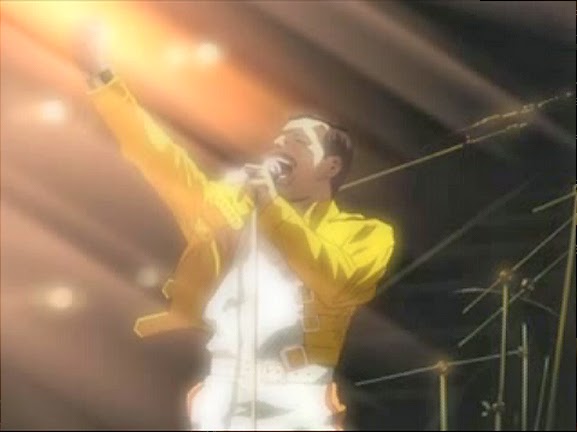
Little did I realize at the time that “Cromartie High School,” actually had Freddie Mercury as a reoccurring character throughout the show. I have never seen “Cromartie High School” and while it does look terrible I have to admit I really like the idea of Freddie Mercury as an anime character.


Freddie Mercury as an anime character. It just feels right.
Perhaps the most obvious reference Japan made to Queen was when Enix produced the Super Nintendo role playing strategy game “Ogre Battle: The March of the Black Queen.”

I love “Ogre Battle” for the Super Nintendo. I loved how the units could upgrade their class at certain levels assuming their stats were good enough. They did a really good job of making you care about each individual unit you had and in an army of them. In both games there was a whole bunch of special characters you could convince to join your army if you made the right decisions. How you played the game and who you had in your army determined how the game would play out and what ending you would get. The Super Nintendo was my heyday for playing video games, and while I am not much of a gamer now you should still trust me “Ogre Battle” is awesome. Ironically there are no ogres in the “Ogre Battle.”

“Ogre Battle” the game was released in 1993 and I am kind of ashamed to admit that I did not get the Queen references back then, but in my defence the only Queen songs they played on the radio at that time were “We Will Rock You,” “We are the Champions,” “Killer Queen,” “Bicycle Race,” and “Fat Bottom Girls.” You can imagine my delight upon discovering that one of my favourite games was named after not one, but two, Queen songs. Those two sons are of course “Ogre Battle” and “March of the Black Queen,” both tracks from “Queen II.”

“Queen II” is predictably Queen’s second album. Released in 1974 and immediately following their debut album Queen took a turn to the fantastic. The concept album is the telling of a strange story about the White Queen and the Black Queen where nearly every song blends into the next like one big rock opera. On the original release of the album, the record had the first side dedicated as the white side and the second side dedicated as the black side, a novelty lost to us in our modern digital world. The band wore all white on the white side and all black naturally on the black side in the album art.

The first side, the white side, is playful. The White Queen is depicted as an object of celestial beauty and worthy of her monarchal rule. The White Queen is the good queen of this fantastic tale.

The White Queen (As It Began)

Meanwhile the second side, the black side, is war. It starts with “Ogre Battle” a rather enthusiastic song about war, so much so, I wonder if it is actually about theatre and play, and not a literal battle. The Black Queen described to us in “The March of the Black Queen” is a powerful and terrible ruler, but still a temptress and worthy of our allegiance - “I'll be your bad boy - I'll do the march of the Black Queen.”

The March of The Black Queen

I am no expert in
fashion. That is all.

The theme of black and white goes further still, as Queen began to wear black and white spandex outfits in many of their live performances, including the music video for “Bohemian Rhapsody” where this outlandish clothing is made most famous. It is impossible to ignore the double entendre of a dueling white and black Queen, some strange self insertion of the band’s personification is being done on “Queen II” not entirely dissimilar a concept to the character “Pink Floyd” in Pink Floyd’s “The Wall.” Is Queen the band both a beautiful fair angel and a dark powerful sorcerers? And what does that even mean? Both aspect of Queen are vague enough to mean pretty much anything and both are presented in a rather positive light. In fact both the white queen and the black queen come across as beings of great love and admiration; funny how love is.

Despite being a lesser known album by the hugely successfully band, “Queen II” has had a major artistic ripple throughout Queen’s creative approach, especially during their early years; also it is one of my favorites, partially because of the connection it has to “Ogre Battle” the Super Nintendo game, but also because of the weird fantastic voyage the lyrics and instrumental take us on. It should be noted that Brian May is often overlooked as the truly phenomenal guitar player he is. There are some fantastic tripped out bridges and solos through “Queen II” and “Ogre Battle.” Also the lyrical content is superb, I have spent a lot of time wondering what the two way mirror mountain might be like, twin mirror-mountains with two paths, a mountain that can only be seen from one side, or maybe a mountain made of mirrors.

Then “Queen II” ends with “The Seven Seas of Rhye” which is the most fun a song has ever been. The original self titled Queen album ended with “The Seven Seas of Rhye” but that version is an instrumental, “Queen II”’s version has lyrics which makes it a superior drinking song, and you cannot have a song metaphorically reference seas made of liquor without it naturally becoming a great drinking song.

The Seven Seas of Rhye

Queen Endora is the Black Queen
in Ogre Battle.  Nice pants.
I could make an effort to imagine exactly what sort of fantasy adventure is going on in “Queen II” but, others have already done a much better job of conjuring up an explanation than I could: http://home.netcom.com/~zmoq/pages/queenii.htm, the land of Rhye? That’s awesome. However I like to believe the story of “Queen II” is exactly like the video game “Ogre Battle,” just because. There are dragons and sky knights and it is so much fun when your knights and valkyries hit level fifteen and you can turn them into paladins and muses.

There was a second ogre battle games for the Nintendo 64 titled “Ogre Battle 64 – Person of Lordly Caliber.” I am worried to admit that if “person of lordly caliber” is a Queen reference, I do not know it. “Ogre Battle 64” was also a great game they fixed a few things that were not perfect about the original, also you get to battle ogres this time around.

I really, really like “Ogre Battle” the song and all of "Queen II," it is just such a wonderfully strange song and album, and as far as I can reason the rest of Queen’s musical career, and the video game of the same name, are the logical conclusion. Majestic and outlandish “Ogre Battle” and the white and black queens set a path of adventure and spandex for one of Britain’s greatest rock bands ever, and of course Japan loved it.

Until next month, keep on rocking in the free world.

- King of Braves

Saturday, March 8, 2014

Queen - Bohemian Rhapsody


I am old enough to remember Freddie Mercury’s death. I would have been eight years old at the time and I had no idea what being gay meant or that Freddie Mercury was the Emperor of gay people. All I knew at the time was that the really cool dude who sang “We Will Rock You” and “We are the Champions” was dead, and it was sad.

It is claimed that Mercury’s death had a powerful effect on record sales, as is often the case with post-mortem success. It has been estimated that Queen’s albums have sold more copies in the past twenty years than they ever did during Freddie’s life, though that could easily be explained by a new generation discovering Queen and global population growth. For me the impact of Freddie’s death meant something more meaningful. I was once in a dialogue with someone about mentally strong people in music and the first person that came to mind for me was Freddie Mercury. Here was this flamboyantly gay man fearlessly leading an eccentric rock band with such supreme confidence that he was able to commanded great respect from everyone, including homophobes. More than that even, he was dying of aids for a long time and he never said anything, he never let on that he was in pain. It takes a very strong person to limp towards death and never utter a complaint or even let it show. He died bravely and I really respect Freddie Mercury for that.

Something else interesting happened around that time. The sudden explosion in Queen’s new found popularity caused a shift in the specifics surrounding Queen’s popularity. What I mean by that last cryptic sentence is that “Bohemian Rhapsody” grew in international appeal more so than any other Queen song. When I was a child the only Queen songs I ever heard on the radio were “Bicycle Race,” “Killer Queen,” “Fat Bottom Girls,” “We Will Rock You” and “We are the Champions.” “We are the Champions” was always played at the end of every Stanley Cup final winning game, so I was quite familiar with it. So sometime during the nineties “Bohemian Rhapsody” overtook every other Queen song as the general consensus epoch of the group.

I sometimes wonder if this scene from the movie “Wayne’s World” might have something to do with it;

“Bohemian Rhapsody” is a six minute wild ride. It is a leaping song of highs, lows and odd turns, both in style and delivery. It is no surprise why everyone loves it so, but what does “Bohemian Rhapsody” mean?

Bohemian:

- A native or inhabitant of Bohemia. (The Kingdom of Bohemia currently resides within the borders of the Czech Republic)

- A person who has informal and unconventional social habits (artist or writer)

Rhapsody:

- An effusively enthusiastic or ecstatic expression of feeling.

- An epic poem; or part of it, of a suitable length for recitation at one time.

Bohemian Rhapsody:

- An epic song by Queen, possibly about an unconventional person who may or may not have been Czech?

I think it is safe to say that Freddie Mercury was himself an informal, unconventional person, and I also think it is safe to extend these qualities to the “poor boy” in “Bohemian Rhapsody.” Furthermore it is fair to presume the rhapsody part of the song is purely musical pronouncement, however... I wonder if there is a deliberate connection to Franz Liszt “Hungarian Rhapsody.”

What you never heard of Franz Liszt or “Hungarian Rhapsody?” Don’t fret, that’s why the Music In Review exists.

The “Hungarian Rhapsodies” is a nineteen set piano piece of classic music themed around Hungarian folk lore. While many of the songs within the “Hungarian Rhapsodies” were written by upper class Hungarian peoples, Liszt added a strong touch of dance qualities to the piano’s sound and mixed in the flavour of gypsy stylization of the time, which consisted mostly of improvisation that included jumps in tempo from slow to fast. Almost like a poor boy showing up to a rich gala or opera and shaking everything up.

“Hungarian Rhopsody no.2” is the most famous of the nineteen piece set;

Hungarian Rhapsody

Perhaps there is a greater connection between “Bohemian Rhapsody” and “Hungarian Rhapsody” than I know. I do not know enough about Hungarian folk lore or the stories being represented by Liszt in “Hungarian Rhapsody” so I cannot make a connection in story between the piano concertos and Queen’s rock and roll masterpiece. However I think there is something to the similarity in names, after all the kingdom of Bohemian is not geographically very far from Hungary, and it is not as though there are a great many song titles out there containing the word rhapsody in relation to a central European kingdom. I believe there is a connection between the two pieces of music but it does not really clear up the mystery of “Bohemian Rhapsody.”

A lot of my friends on Facebook.com keep posting memes about how great Freddie Mercury, Queen, and “Bohemian Rhapsody” are and rightfully so. Among them was this image;

...it’s the story of a boy whose girlfriend left him for some other guy. He kills him, now the gang of that guy is looking for him. He goes to say goodbye to his mother before the gang finds him. The ‘opera’ part is the gunfight, where the gang mocks him for being a ‘just a poor boy.’”

“They shot in the air, which is the thunderbolt and lightning. He begs, but they won’t let him go. So he kills them all. ‘So you think you can stone me and spit in my eye?’ as he celebrates.”

“But still, he knows he’ll have to spend his life as a fugitive. He needs to ‘get right out of here,’ which explains the melancholy at the end. Even though he came out alive, he’ll never see his mother again.


That is a good theory about “Bohemian Rhapsody,” but I am not convinced it is altogether accurate. I think we can all agree the catalyst of the story resides within the murder of a man. The narrator is the most likely guilty culprit as he confesses the crime to his mother;

“Mama, just killed a man,
Put a gun against his head,
Pulled my trigger, now he's dead.”


And laments the actions;

“Mama, life had just begun,
But now I've gone and thrown it all away.”


I have always interpreted the main body of “Bohemian Rhapsody” as the trial of this young man who has committed murder. The accused is “just a boy poor” and struggles to defend himself because he is overcome with guilt, which he expressed earlier in the song to his mother, and also perhaps because he is “poor” and unable to stand up to the heavy hammer of the law or a legal system that has always favored the rich, and the plaintiff openly mock him;

“I see a little silhouetto of a man,
Scaramouch, scaramouch will you do the fandango,
Thunderbolt and lightning very very frightening me.”


I had always interpreted the “thunderbolt and lighting” as the sound of the judge’s gavel crushing down dramatically spelling the end of the trial and the doom of our protagonist.

First our protagonist pleads for mercy;

“But I'm just a poor boy and nobody loves me.”

And finds some support;

“He's just a poor boy from a poor family,
Spare him his life from this monstrosity.”


The debate rages on and eventually “the poor boy” loses his temper and shouts at his accusers in one last desperate effort to fight for his freedom,

“So you think you can stone me and spit in my eye.
So you think you can love me and leave me to die.
Oh baby can't do this to me baby.
Just gotta get out just gotta get right outta here.”


And at last he accepts his fate, because “nothing really matters.”

That is what I always thought was going on, but I want to know what you think.

We may never know exactly what was going on in Freddie Mercury’s mind when he wrote “Bohemian Rhapsody.” Mercury was a strange animal and part of his mystique was his outlandish style and how it melded with his tremendous imagination and this only adds to the mystery of “Bohemian Rhapsody” because any theory, no matter how informal or unconventional is potentially accurate, as suggested by Mercury and his very deliberate choice of title for this epic poem.

- King of Braves