Search This Blog

Saturday, May 23, 2015

M83 - Graveyard Girl


I keep bumping into M83, and from a variety of sources.

The French electronic band has been around for a while, since 2001, but it was not until 2006 when founding member Anthony (Yann) Gonzalez took things into a different, slightly more experimentative direction. The other founding member Nicolas Fromageau had left in 2005 and this left Yann in the lone position of creative control, and it was sort of like he was let loose. The songs I am encountering by M83 that are endearing me to them all seem to come after 2006. In fact more specifically I am growing very fond off M83’s last two albums “Saturdays = Youth” (2008) and “Hurry Up, We’re Dreaming” (2011).

M83 has a weird sound to them, it is not entirely unique in the style of modern music making but there is enough of an individual flare that makes them, at least to me, stand out. They sort of remind me of Daft Punk with the effort of atmosphere like Sigur Ros, or maybe something like MGMT. I do not know, this genre, whatever it is we call it these days is not exactly my most familiar, but I do know I like it. However for the sake of pinpointing a specific track to ramble about I elect one of M83’s tracks that sounds a little more simplistic, a song a little less dependent on the power of technology, “Graveyard Girl.”

While the majority of M83 tracks are very processed and rely heavily on the synthesizer keyboard, “Graveyard Girl” has a fun upbeat rhythm section composed of the keyboard, naturally, and a nice beat from the drums. The drums are a little more noticeable in this song compared to other M83 songs because it does not exists so much in the shadow of the keyboard, and I like it. Also there is a lead guitar, and again when compared to most M83 songs, it too gets to shine a little more than usual because the keyboard is a little more relaxed. In fact, relaxed, or perhaps, mellow, would be a fitting one word description for this tune. Do to the mellow nature of the song a clear symmetry flows through, very much like every M83 songs, but this one is more subdued, less energy, more emotion, or something like that.

When listening to other songs I really enjoyed by M83 such as “Midnight City” or “Wait” it is impossible to deny just how much M83’s sound is very processed; so much so it sounds very much like they are relying on a machine to do the work for them. However there are lots of bands out there like that right now and I’ve seen Foster the People live, they had a whole band and everything, they were real musicians. Judging from the live performance of “Graveyard Girl” I guess the same conclusion can be drawn for M83:


The lyrics are fun.

“Death is her boyfriend.
She spits on summers and smiles to the night.
She collects crowns made of black roses,
But her heart is made of bubble gum.

Graveyard girl

Dark rags and red stars.
She's the dirty witch of her high school.
She worships Satan like a father,
But dreams of a sister like Molly Ringwald.”

The music video had a look reminiscent of “Pretty in Pink” or “Sixteen Candles,” what with an awkward red haired girl in high school being the “Graveyard Girl,” then you pick up on the “Molly Ringwald” name drop and everything makes sense.

In this day in age, most of us, if not all of us, probably know a girl like the one described in “Graveyard Girl.” Some young goth girl, who believes herself to be a lot deeper and mature then she really is, and despite this warped sense of self, that is somehow both egotistical and self-loathing, there is a intelligent light behind her eyes and true poet’s heart beating in her chest. I wonder if Yann has read much Christopher Moore, because “Graveyard Girl” makes me think of Abby Normal, from his San Francisco vampire stories.

The only other spoken words in the song come to us in a monologue from the “Graveyard Girl” herself, which I believe help cements my theoretical comparison:

"Graveyard Girl" by Unearthlydreams
"I'm gonna jump the walls and run
I wonder if they'll miss me?
I won't miss them
The cemetery is my home
I want to be a part of it
Invisible even to the night
Then I'll read poetry to the stones
Maybe one day I could be one of them...
Wise and silent
Waiting for someone to love me
Waiting for someone to kiss me
I'm fifteen years old
And I feel it's already too late to live
Don't you?"

Yeah that is the kind of stuff an Abby Normal like character would say. Maybe it is not sarcastic enough, but still. Clearly there is a great deal to enjoy here, fun song, fun lyrics, great possible connections to a variety of girls, both real and fictional.

Until next month, keep on rocking the free world.

- King of Braves

Thursday, May 7, 2015

Blackmore's Night - Shadow of the Moon


I have written before about how the older someone gets the more mellow they become and we see this happening to effectively every musician who has ever lived. Ritchie Blackmore is no exception to this rule. He went from being the most memorable member of a classic rock band often credited for laying the ground work for heavy metal and now... well now he is doing something completely different.

In 1994, approximately, Ritchie Blackmore left Deep Purple, this time for good. In 1997 Blackmore with his then fiancée Candice Knight formed the aptly named two piece band Blackmore’s Night. This new band and new direction by Blackmore is completely different from everything he had created previously. Blackmore’s style mellowed dramatically, and under the banner of Blackmore’s Night he took to writing festival like folk music along with a variety of guitar focused cover songs both from classic rock and old classical music. It was like he traveled backward in time, like five hundred years, and got in touch with his inner minstrel. This change was unprecedented, and it has left many loyal Blackmore fans surprised and saddened. They do not want Blackmore to play at renaissance fairs (no really that is what Blackmore is doing now) they want him to play classic Deep Purple and Rainbow songs.

I too love Deep Purple and Rainbow, I too want Ritchie Blackmore to play “Child In Time” and “Stargazer,” but I also love Ritchie Blackmore and I want him to be happy, so I am perfectly okay with him playing classic guitar and classic inspired guitar music with his wife at renaissance fairs. It helps that Blackmore’s Night is also really good.

As a young person, Candice Knight was a huge fan of Rainbow, and she met Ritchie at a signing event, or something like that, and they got to a talking and realized they had a lot of common interests and became friends. For a short time Candice did backing vocals for Deep Purple but by 1994 Ritchie left the band, this time for good, and took his then fiancée with him.

They look happy to me.
Candice Knight is very pretty and I mistook her for a model, partially because she as a glow about her that would have made her a successful model if she had chosen that career, but also partially because it is a classic outcome for a rock stars to marry supermodels. For me there was an immediate concern seeing just how pretty and young Candice was, she is twenty-six years younger than Ritchie and naturally my first fear was that Ritchie was going to lose half of his stuff. However it does not appear that way at all, not only do they seem legitimately happy together, but they have now been together for two decades or more. Furthermore they share music, the single biggest aspect of both of their lives and that must be a beautiful connection to share with someone you love. So hurrah some stories have happy endings.

This is normally where I bring up a specific song to talk about, because I know the attention span on the average person these days struggle with a whole band or even album, but I found it incredibly hard to pick just one song by Blackmore’s Night. As of today Blackmore’s Night has released nine studio albums, which yields a lot of material to listen to and enjoy, which also leaves me with a lot of options to choose from. So somewhat randomly I am going to talk about “Shadow of the Moon.”

“Shadow of the Moon” is the title track off of their first album, released in 1997, so it seems a good a place to start as any for a dialogue about Blackmore’s Night.

One thing I like about “Shadow of the Moon” is it reminds me a little “Green Sleeves” the old English folk song, but I hear that song everywhere, possibly because it is one of the first songs I learned to play moderately well on guitar. Naturally Blackmore’s Night also does a cover of “Green Sleeves,” of course they do, that’s their thing. The folk styling of old medieval is a constant theme throughout Blackmore’s Night entire body of work and the charm that offers is present also in “Shadow of the Moon.” I really appreciate now Blackmore and Knight are able to create so many songs that sound like the style of the past. I am constantly forced to look up their songs to see if they are old songs I am unfamiliar with, sometimes they are, but mostly they are original tracks either composed of various past inspirations or completely new pieces of work. Every time I discover another song that sounds like it came from Camelot and it was created in the modern time I am impressed with just how in tune with this style Blackmore and Knight have become.

While the original work is definitely the most impressive content by Blackmore’s Knight I am very fond of their cover of Bob Dylan’s “The Times They are a Changing,”

The Time They Are a Chagin

That music for “The Times They are a Changing” in particular really captures what I really like about Blackmore’s Night, Ritchie and Candice seem so damn happy. Ritchie has always been a very relaxed individual, never seeming to get to excited, but seeing him jamming out with a very happy blonde angel with a super nice smile makes me all feel warm inside. It seems like they are really happy.

So If you still feel sad that Blackmore is not playing “Child In Time” anymore, check out this live performance:

Child In Time - Live

"Sisters of the moon," hippier words have never been spoken.

What was that? A French horn? The point is you might get to hear “Child In Time” or some other Deep Purple or Rainbow classic at a renaissance fair, or some other medieval theme festival, someday. I have to say, think we have a winner in Blackmore’s Night.

- King of Braves

Saturday, April 18, 2015

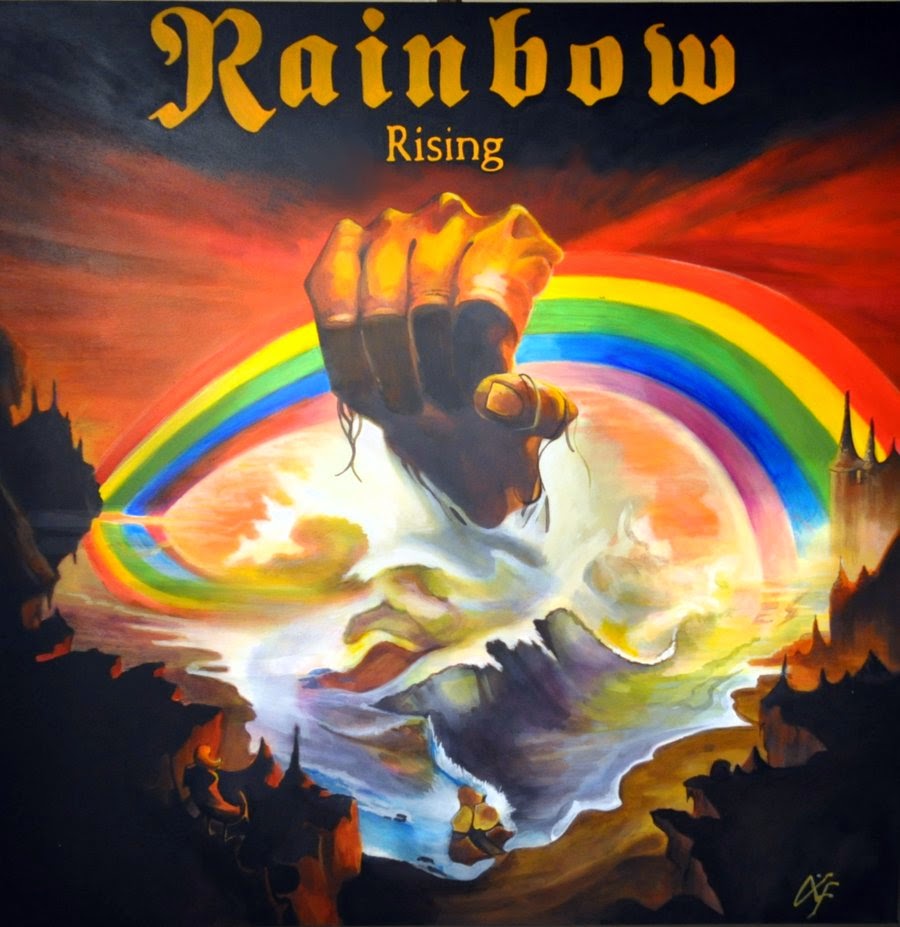
Rainbow - Stargazer


In 1975 Ritchie Blackmore left Deep Purple, at least for a while. Blackmore was temporarily replaced by Tommy Bolin but by March of 1976 the band split up, and I have to suspect the primary reason had something to with Blackmore not being there anymore. The only original members by that time were drummer Ian Paice and Jon Lord on keyboard. Thus began the nine year hiatus where Deep Purple did not exists, allowing Blackmore, Lord and Paice to lend their skills elsewhere, in solo acts and other bands. Blackmore, the main man of the hour, formed the band Rainbow with his friend Ronnie James Dio.

Deep Purple has experience massive turnover over the years but Rainbow is an even more chaotic lineup of changes in a much smaller period of time with the only constant factor being Mr. Blackmore himself. However it is clear that Ritchie Blackmore is Rainbow. It is his project, so everything fits just fine. However most people remember the first three albums most fondly, and part of that I suspect has to do with Dio’s presence.

Before Rainbow Dio was the front man for a band named Elf, and that name alone pretty much tells you everything you need to know about Dio (originally the band was named The Electric Elves). Ronnie was big into fantasy and rock and roll, it could be argued that he was the original power metal front man and because of this he has endeared himself to many.

Dio & Blackmore
Blackmore a somewhat underappreciated guitar legend and Dio a somewhat ineffectual but lovable front man both offer a special something, and when combining their talents we did get something special, something like fantasy, we got power metal. Rainbow is a high point for both men in their legendary careers.

It was on Rainbow’s second album “Rising” where my favorite Rainbow track resides, “Stargazer.” There is a variety of reasons why a song like “Stargazer” appeals to my likings. I have always loved long epic rock songs that take us on an adventure and “Stargazer” at eight and a half minutes accomplishes this. Also it tells a story about the failure of religion, and that is something I can always get behind.

The lyrics introduce a community of people building a tower for their messiah so he can fly off and reach the stars. The horrors of this blind devotions are presented from the perspective of a believer and with that Dio emotes a passion for the hopeless project, casually brushing off, or perhaps even lovingly embracing the grim sacrifices these people have to make for their beliefs, in fact every verse builds upon this suffering:

“High noon, oh, I'd sell my soul for water,
Nine years' worth of breaking my back.
There's no sun in the shadow of the wizard.
See how he glides, why he's lighter than air.”

And;

“Hot wind moving fast across the desert.
We feel that our time has arrived.
The world spins while we put his wing together.
A tower of stone to take him straight to the sky.”

And also;

“But why? It don't rain with all our chains,
Did so many die, just to see him fly.
Look at my flesh and bone.
Now look, look, look, look, look at this tower of stone.”

By the final verse it has been revealed that the “wizard” was a false prophet as “he falls instead of rising” once atop the tower. These verses show us that not only are these people desperate, dying of thirst, but they are literal slaves to the construction of this pointless holy tower. However we do get a small silver lining at the end, after the wizard has fallen and died, a rainbow, how appropriate, can be seen on the horizon;

“I see a rainbow rising, look there on the horizon,
And I'm coming home, coming home, I'm coming home.

Time is standing still, he gave me back my will,
Oh, oh, oh, oh, going home, I'm going home.
My eyes are bleeding and my heart is weeping,
We still hope, we still hope, oh.”

Weird but lovable Dio
It is a dark story but freedom and release is accomplished by the end. This fictional narrative is realistic insofar that it likely takes a disastrous event for the blind faithful to realize the torture of their chains either physical or psychological. It is a message that has become well communicated to the world at large but is a message worth repeating indefinitely and in 1976 this was probably a very unpopular message. There is presumably some degree of courage by Blackmore and Dio to so abrasively release this song at the time, but they were not alone, Black Sabbath’s “Sabbath Bloody Sabbath” has similar sentiments but still they were clearly progressive in this manner of thinking. Nonetheless I feel “Stargazer” is not just a really great song in Ritchie Blackmore’s history but I feel it also captures the best of Dio. As I stated Dio was never the most effect front man, but he had a charisma about, and he had a good heart and wild imagination and I think we see all of that on display in “Stargazer.” It is a song that is both fantastic and political, it may have certain level of magic in it, but at the same time is a sincere plea to reason, and I feel that is what Dio was all about.

Until next month keep on rocking in the free world.

- King of Braves

Ironically most of the images of the band Rainbow are in black and white.

Friday, April 10, 2015

Deep Purple - Child In Time


Looking backwards Deep Purple was a troubled band. Most bands don’t have four lead singers, four lead guitarist, three bass players and two keyboard players over its history. Most bands never have an issue maintaining a consistent front man in the role of lead singer or lead guitar, most bands dissolve when the theoretical leadership roles experience routine turnover (lead guitarist Ritchie Blackmore was present for all the most significant moments in the band’s history). Most bands do not cease to exist for a decade (between 1976 and 1985). Most bands would be unable to produce nineteen studio albums with all of these difficulties confronting them.

Despite plenty of critic appeal and a fine stable of radio hits Deep Purple is rarely mentioned among the all time greats of classic rock and have yet to be inducted into the rock and roll hall of fame.

What’s up with that?

I wonder if the constant change over of lead singers and the large gap of time where Deep Purple did not exist or if any of the other inconsistencies in their line up and presence may have harmed Deep Purple in some culturally successful way. They are kind of a funny band in that way, Deep Purple is just on the fringe of being considered one of the all time best bands of all time in the minds of most, yet they are also similar to other cult rock and roll bands who have a devout following and are largely ignored by the mainstream. They act more like a cult band, constantly touring and making music regardless of sales of approval. I wonder if Deep Purple is the most successful cult band that remained a cult band, or if they are a successful band that is to some degree taken for granted.

Now for an anecdote:

Many moons ago I was working the kitchens and my co-worker asked me if I had any classic rock on my MP3 player, of course I did, who the hell do you think I am? He asked me what I had so I listed off the greats, Zeppelin, Floyd, Who, Beatles, etc.

“What about Deep Purple?”

I had like four songs by Deep Purple. The four you would mostly often hear on the radio, “Smoke on the Water,” “Space Trucking,” “Highway Star,” and “My Woman from Tokyo,” I might have had “Hush” as a fifth. My co-worker was unimpressed. He counted Deep Purple among the greats and I had a meager number of songs to show for them on my personal collection. I did not even have “Child In Time.”

The first major track to force a reinvestment of my attention in Deep Purple was “Child In Time,” a song you will probably never hear on the radio but was from most peoples’ perspectives the first truly great Deep Purple song. The first three albums Deep Purple released were consumed with cover songs, and it was not until their fourth album “Deep Purple In Rock” (1970) did the band finally release an album that was comprised entirely of original material. As a result “Child In Time” is often cited by critics as the turning point for Deep Purple, Roger Glover was now on Bass and would be forever thereafter, all tracks were original, and frankly most people would agree that “Deep Purple In rock” was the best album produced by the band thus far at that time, and may would agree hence forth thereafter.

“Child In Time” is a perfect example of the experimental style of 1970. It is a ten minute odyssey full of daring new approaches to sounds creation and presentation. The sound of “Child In Time” fits right in with Emerson Lake and Palmer, or The Moody Blues “Beyond a Threshold of Dream” which came out the year prior. Progressive rock advanced yet another step forward thanks to Deep Purple and “Child In Time” and as such many Deep Purple fans recall it as the epoch of all men involved careers.

The popularity surrounding “Child in Time” is not dissimilar to Aerosmith’s “Dream On.” Many hardcore fans would point to the early masterpiece of both bands careers as being their finest work, but most people are either unfamiliar with or less familiar with those songs as they are with the radio hits, the more conventionally popular. In “Child In Time’s” case the length alone made it taboo for radio play and thus missed entirely by a significant, and disappoint, number of people.

Everyone knows, or at least should know, that Ritchie Blackmore is a fantastic guitarist, and I really like the dropping rhythm that carries the verses and bridges through the song, but I think extra attention should be given to the keyboards specifically. There is a wild and lengthy keyboard solo which may be Jon Lord’s best work, I do not know, I am still discovering more about him.

I have joined the camp of Deep Purple fans who point to “Child In Time” as their magnum opus.

- King of Braves

Saturday, March 14, 2015

Jimmy Page & Robert Plant - When The World Was Young


Despite being underappreciated Jimmy Page and Robert Plant’s Unledded live album “No Quarter” was a big enough success to reignite the average rock and roll fan’s interest in new Led Zeppelin content, as well as inspire confidence enough in record producers to invest in new original material written by Page and Plant. The end result was the only studio album Jimmy Page and Robert Plant ever recorded together as a duo act, 1998’s “Walking Into Clarksdale.”

For the sake of thoroughness it should probably be noted that Jimmy Page did collaborate with Robert Plant on most of his solo albums, and Robert Plant lent his voice to at least one song on Jimmy Page’s solo album, so “Walking Into Clarksdale” was not exactly a new concept when examining the actions of both men nearly two decades after the breaking up of Led Zeppelin, but it is the only official time they worked together as a due to produce a studio album credited to both of them.

“No Quarter” was underappreciated, but “Walking Into Clarksdale” was criminally underappreciated.

According to the records “Walking Into Clarksdale” was well received in Europe, but when it came out I could not find anyone, aside from my big brother, who had bothered listening to it, and I mean at all, and that is still true even to this day. It would appear that even the most diehard Led Zeppelin fans have no idea what “Walking Into Clarksdale” is, and I often wonder why that is.

It might have something to do with the fact that the sound on “Walking Into Clarksdale” is very different from the Led Zeppelin classics. The early day works of Led Zeppelin were hard rock, even some metal fans try to claim Led Zeppelin as “early metal,” even though the later albums were beginning to show a sign of slowing down. Come 1998 the music Page and Plant were interested in creating was significantly slower and moodier than what they created in the late 1960s and early 1970s, and people who fail to realize that people change with time, apparently held that against the album. Newsflash, virtually everyone calms in their later years, most musicians and their body of work show this.

Another thing that I suspect might of have hurt “Walking Into Clarksdale’s” commercial reception was the choice of single, “Most High,” a song which I feel is the absolute middle mediocre example of what the album has to offer. However apparently “Most High” did win an award of some kind, so what the hell do I know? Also the title track left a lot to be desired by me, and I imagined others feel the same, it was a disjointed song, decent, not great, and along with “Most High” these would be the probably first two tracks the casual audience was exposed too. Meanwhile the best songs on the album went unnoticed, songs like “Blue Train” a heartfelt final goodbye by Robert Plant towards his son who died in a car accident many years ago; or “When I Was A Child” a gloomy song about growing older and the illusion of innocence dying; or “Shinning A Little Light” an upbeat love; or “Heart In Your Hand” a dark desperate song about putting, well, your heart in someone else’s hands; last we have the song of the hour “When The World Was Young.”

Sometimes it is easy to pick a favorite song off an album.

“When The World Was Young” is a fantastic song. It is reminiscent of Zeppelin classics like “In The Light” or “Ten Years Gone.” It has that sort of grandiose epic quality to it with great rising action, that I always love, slow methodical beginnings with a gradual increase in intensity climaxing with a dramatic rock and roll assembly of layered sounds and ending with a slowing outro. I really enjoy Jimmy Page’s guitar work in this song, after every verse there is a nice short flare of strums that really stand out and give the song a great flow, and it is also a song that is comprised mostly of unique note pickings which make it akin to a classic guitar song, which I am very fond of.

We would normally not think of a song like “When The World Was Young” as a heavy drum song but there is something worthy of mention about the drums in “When The World Was Young.” Songs like “When The World Was Young” are emotional and tender, so a heavy rhythm section is the last thing we would expect, but by the time the climax of the song comes along Michael Lee’s drums have picked up to an agreeably rock solid pace and Charlie Jones’ bass is in there too intensifying the volume, the emotion and the whole song. Working with gods like Page and Plant we are likely to forget who Jones and Lee are, so it is only fair we give them the credit they deserve for their part in “When The World Was Young” as well as the rest of the album “Walking Into Clarksdale.”

Examining the lyrics we are once again, as usual when studying the mind of Robert Plant, met with a great openness for interpretation. Any number of potentially mythical or impossible beings may be referenced. I like to think the song is about an immortal “I’ve been here since all time began” and “my footsteps through eternity.” Or course this being Robert Plant the lyrics are about love, only this time maybe an ancient lost love.

“I saw you,
I knew you,
I touched you,
When the world was young.”

This simple, yet powerful, chorus just sends my mind into a cosmic dance of ideas. Is it about an immortal, or maybe a god, reminiscing about someone they once knew? Maybe I got it backwards and it is about an aged mortal human reminiscing about their long ago contact with a magical being, when the world seemed young. Again though I like to invoke the element of romance, and think this is a song about a long lost love. The chasm of experience between youth and older age can seem like a worldly long time.

I used to think the chorus was saying “him” not “you,” and this gave me two possible ideas about who “him” was. I thought perhaps it was a god, or just god if you prefer, and Plant was singing about some religious experience, or, perhaps more personally entwined, I thought it possible that Plant was singing about his lost son, the one who died in a car accident, the same one he is singing about in “Blue Train.” I do not think these two theories work however, because the earlier exploration of romance just fits too well, “home of my heart, take me dancing.”

For these reasons, as well as a bunch of other I may have lacked the insight of elegance to elaborate on are why it is easy to understand why “When The World Was Young” is a great song. It is the masterpiece of Page and Plant’s later career and it stands as the triumphant gem off of an album that is filled with very majestic tracks of matured minds. Not only does “When The World Was Young” stand alone as a get song, but it harkens back to the sort of Zeppelin produced on “Physical Graffiti,” and not only that it is the epitome of why later day works by Page and Plant should not be overlooked. It is the single biggest reason why “Walking Into Clarksdale” is an underrated album.

Until next month keep on rocking in the free world.

- King of Braves

Wednesday, March 4, 2015

Jimmy Page & Robert Plant - Wonderful One


Led Zeppelin is the best thing that ever happened. That is not hyperbole.

Sometimes people actually argue what was the greatest classic rock band of all time, and the other nominees are typically The Beatles, The Rolling Stones, and Pink Floyd, all of which are insanely awesome bands, but I am very steadfast in my opinion that Led Zeppelin takes the prize and in a big way.

The only real argument that might hold some ground as to how Led Zeppelin is not the greatest band of all time, is the idea that after John Bonham died Led Zeppelin never did much, which is true because the band never came back together with a new drummer to make any new material, however, if you think Jimmy Page and Robert Plant simply spent the last thirty six years staring at the walls of their gothic-Celtic castles you would be very wrong.

Robert Plant has had ten solo albums since Led Zeppelin, which is one more then there are Zeppelin studio albums. Meanwhile Jimmy Page had a single solo album in 1988 titled “Outrider” and collaborated with Roy Harper, The Firm, David Coverdale and The Black Crows on studio and live albums. All of these things flew under the radar of the popular listening audiences and this is understandable to a degree since none of these things Page or Plant contributed too captured the perfection that was Led Zeppelin, except when Page and Plant worked together and unfortunately almost no one paid attention to that either.

Page and Plant reunited in 1994 and decided to perform many of the Led Zeppelin classics with a different style, a more acoustic style, with a Moroccan flare I believe. They never recorded these new realizations on a studio album, instead they took their idea on tour, to Morocco I guess, and recorded a live album titled “No Quarter” named after the popular song from 1973’s “Houses of The Holy.” The new style was slower and this ironically did not really work for the most famous songs off the album “Kashmir” and “No Quarter,” at least not in my opinion, but it did work for more emotional songs like “Thank You” and the “That’s The Way” and Page and Plant basically reinvented “Nobody’s Fault But Mine” and for the better in my opinion.

All and all the recreation of the Zeppelin classics was largely a fine artistic endeavour, but that alone may not warrant a great deal of attention, and evidently we can see that it did not, and I wonder if the commercial success and popular appeal of the “No Quarter” album might have been strengthened if a greater emphasise to the original tracks had been made. There are three original tracks on the live recorded album and a forth on the DVD. “Yallah” or “The Truth Explodes” is the first to appear on the playlist and it is very influence by the Moroccans. “City Don’t Cry” is a very sweet tribal song about the love of the city and the spirits within. “Wah Wah” is the single that did not make it to the original recording and it falls into a similar vein as “Yallah.” The song that matters the most and I think deserves a lot more attention, even though it was a single off of the album, is “Wonderful One.”

“Wonderful One” is definitely the best new song, and quite believably the best track off of, “No Quarter.”

Sometimes the best sign of a really good musician is now they show restraint. We all know what Jimmy Page is capable of, how fast and intricate he can play, he is literally the best who has ever lived, so when he plays nothing but a collection of repeating guitar licks that dance about the mist of the steady drum beat, there is a reason for it, and that reason is that it is beautiful. The only deviation in any instrument during “Wonderful One” from the opening set pattern is the lead guitar during the chorus in which case it sounds like the same chord casually played with downward and upward strokes and nothing more, again further restraint show by Mr. Page, and again it works... wonderfully.

The song structure is dependent on the lyrics. The structure is very simple, verse, verse, chorus, verse, chorus, verse, with the opening verse being the same as the last, brining the song back to continuity. It is within these lyrics where the deepest beauty of all rests.

Robert Plant has written many a sweet love song over the course of his life, but as far as sentimental emotional invocation is concerned, “Wonderful One” may be his best work. Another thing Robert Plant has frequently done is made vague reference to mythical persons, sometimes characters of literature and mythology, sometimes fantastic creatures of his own design. So when he sings about the Queen of Love and her daughter and a golden tongued thief, there could be any number of possible references Plant is making or just a magical scenario he has conjured up all on his own. Dappling with magical suggestions in what amounts to be a love song is highly effective at making, arguably the most powerful human emotion, seem all the more grandiose; this is perhaps felt best in the moving chorus:

“Show me your eyes,
Oh light of the sun.
Touch me with fire,
My mind is undone.
All life inspire,
My freedom has come.
I drift through desire,
My wonderful one.”

“My wonderful one,” is a lovely way to refer to someone you love, it has a nice ring to it.

Robert Plant is hardly the first poet to compare a woman to the sun, but there is some added charm the way this woman lifts the narrative character into a higher state of being. Embracing freedom and conquering desire are signs of enlightenment, and this ties in perfectly with our romantic notions of how love changes everything, for the better, and what a wonderful fantasy that is. This woman, and the love she represents, is the very light of the sun, shining inspiration and hope onto all of us, defying everything, making everything possible; or something like that.

It is a really nice song, listen to it.

- King of Braves

Saturday, February 14, 2015

Jimi Hendrix - Bold As Love


Like any sane person I am very big fan of Jimi Hendrix. The greatest tragedy of Hendrix’s music career is of course its length. Jimi only managed to produce three studio albums before his untimely death and the imaginations of fans and other musicians of what was next to come, what could have been, and what if, have haunted us ever since. Hendrix was a unique talent, he was obviously physically talented in how absurdly well he could play guitar, but he was truly special because of who he was and what he represented. He was a black man in a troubled time who only saw colour in his music, he was a rainbow of complex ideas and emotions.

Not everyone knows this but Hendrix struggled to write music with any sort of uplifting message or theme. His naturally disposition was one of darker inclinations, which makes a lot of sense when you re-examine songs like “Third Stone From The Sun,” “Castles Made of Sand,” or “The Wind Cries Mary.” It is easy to make the accusation that Hendrix’s psychedelic lyrics and guitar licks are the inspiration of drug use, and there is certainly some degree of truth to that, but by focusing solely on Hendrix’s drug habits we do the man and ourselves a great disservices, because the truth is far more splendid. The primary reason for the far out lyrics and ideas in Hendrix’s discography is because he was a deep thinker, which is likely also the reason for his brooding thoughts. The introverted journey into one’s self can be a challenging thing to do, for it can be an uncomfortable exploration, there is more than a drug induced trip in Hendrix’s music there is also a philosophy yearning to be explored and understood. Knowing how Hendrix struggled with being positive gives, to me, a new reflection on some of his sweeter songs. An earnest effort had to put forward to create song like “Bold as Love.”

I am particularly fond of “Bold as Love;” it is a poem with a great guitar outro, but it is also something of a tell all of Hendrix and in fact all people. The nature of “Bold As Love” is very simple, Hendrix assigns a color to each and every one of his emotions, gives them a short and sweet description, and then declares them “all bold as love.” By the end Hendrix declares;

“And all these emotions of mine keep holding me from,
Giving my life to a rainbow like you.”

After all Hendrix is all these different colours/emotions and so is the woman he is singing to, hell she is rainbow, but by this standard so is Jimi, so is everyone.

Any jackass can tell you what you already know about Jimi Hendrix and “Bold as Love.” We all know Jimi is one of the very best guitarists ever, all of us also know already know that Jimi was a one kind musician and individual. It is easy to understand the message of how everyone is a composite of all our emotions and how that fact makes us the complex creatures we are. Yeah anyone can tell you that, so I am going to do something different, I am going compare the characters described in “Bold as Love” to the various coloured lanterns represent the emotional spectrum from the mythology of the Green Lantern. That should be cool.

Hendrix Bold of Love Characters:

Geoff John's Green Lantern Colored Spectrum:

It appears the only colors that Jimi Hendrix and DC comic book writers agree on is yellow. Yellow should be the color of fear. The rest is a scrambled mix and match, and while I can completely visualize Hendrix’s characters in my head, I am very fond of the expanded Green Lantern mythos created by Geoff Johns, and I lean towards his selection of emotional color combination a little more. Still it is arguably completely arbitrary which colors we think represent which emotions, so I suspect there is no right answer.

I searched the web, and I was disappointed to discover that no one has taken to creating some artwork depicting the colorful characters of Jimi Hendrix’s “Bold As Love,” not even on deviant art. Better yet I think it would be cool to see some kind of cross over artwork, like Jimi Hendrix wielding all the corps rings and sending out a rainbow of cosmic beams from his guitar, something like that. I would create it but I have no artistic talent, maybe someone reading this will agree and make it happen, we can only hope.

Until next month keep on rocking in the free world.

- King of Braves

Got to use some of my old photoshop skills this time, only I had to use paint.  Harder then it should have been.