Search This Blog

Wednesday, April 23, 2014

David Bowie - Lady Stardust - He was Alright (Song for Marc)


“The Rise and Fall of Ziggy Stardust and the Spiders from Mars” is a far out concept album. The general premise is that a bisexual alien picks up some radio waves from earth and decides to join in on the fun. However being an outlandish bisexual alien, his vision of rock and roll is radical. This is also set to the backdrop of the earth coming to an end as the opening track of the album is “Five Years” as in “earth is really dying” - “five years, that’s all we got” one of my earliest Music In Reviews tackled that song: http://colinkellymusicinreview.blogspot.ca/2011/03/may-2007-david-bowie-five-years.html and it also topped my list of 27 songs about the end of the earth post: http://colinkellymusicinreview.blogspot.ca/2012/11/27-songs-about-end-of-world.html The final act in the Ziggy Stardust concept album is the song “Rock N Roll Suicide” where the character Ziggy dies and with him the earth goes too, which I believe is meant to metaphorically represent the narcissism of the Ziggy character, as if the world could not go on without him.

In between the announcement about the end of, and the act of, the end of the world, the album takes us on a strange ride with songs of tripped out space rock and roll. Earlier tracks are about Ziggy dreaming of being a rock star like “Moonage Daydream” and “Star” then he decides to come down to earth in “Starman” and by the time we reach tracks like “Ziggy Stardut” and Suffragette City” Ziggy is the world’s biggest rock star, at least in the narrative of the story. Bonus tracks like “Sweet Head” and later on the “Aladdin Sane” album the Rolling Stones cover of “Let’s Spend the Night Together” are bluntly suggestive of Ziggy’s bisexuality, what with him bragging about how good he gives head in “Sweet Head” and transforming one of the most suggestive heterosexual songs on the radio at the time, “Let’s Spend the Night Together,” into a aggressively gay song. Ziggy’s bisexuality may just be scene dressing in the overall concept for the album and story but it is a significant aspect to Mr. Bowie’s life at that time.

Sweet Head
Just in case you were unsure if Ziggy Stardust was bisexual or not.

Now we know what a bisexual
alien rock star looks like.
One might argue that Ziggy Stardust being extremely sexually liberal is not a necessary component to the overall story. An alien becoming a rock star and his death paralleling the end of the earth offers plenty of ideas to work with for a concept album, or arguably two if we include “Aladdin Sane.” However the pronounced moments where Bowie is loudly portraying Ziggy’s sexuality works two fold. First it really emphasizes how “alien” the Ziggy character is, Bowie would wear crazy amounts of makeup when portraying Ziggy in concerts and he also cross-dressed and did all sorts of things to remind us that Ziggy was different, his unconventional sexuality adds to this, but also fits nicely with him being an alien, who might not see sex and gender the same way we do. Second this was clearly a chance for Bowie to broadcast his own bisexuality.

“Lady Stardust” is a very good song right in the middle of this fiasco, I mean both symbolically and literally, literally as in it is the sixth track on the eleven track album. “Lady Stardust” at a glance might appear as if a female equivalent to Ziggy Stardust has joined him on earth, or perhaps this song is to introduce the bride of Ziggy, but even a cursory glance at the lyrics lets us know how extremely incorrect these assumption are:

“People stared at the makeup on his face.
Laughed at his long black hair, his animal grace.
The boy in the bright blue jeans,
Jumped up on the stage,
And lady stardust sang his songs,
Of darkness and disgrace.”

People stare at the makeup on HIS face?

So after learning “Lady Stardust” is about a male rock star wearing makeup and looking feminine, I would naturally think it was about Ziggy Stardust and his cross-dressing and makeup wearing ways. Lured by the music, people are struggling to make sense of the bisexual alien rock star, which is a sentiment I imagine most rock and roll fans experienced with the release of “The Rise and Fall of Ziggy Stardust and the Spiders from Mars.” That makes sense right? This song is actually about Ziggy’s vague gender neutrality and that aspect of himself confusing people here on earth.

However, the original name for “Lady Stardust” was “He Was Alright (Song for Marc)” and the Marc is question is Marc Bolan, front man of T.Rex and inventor of glam rock.

He was Alright (Song for Marc) - Lady Stardust Demo

“And he was alright, the band was altogether.
Yes he was alright, the song went on forever.
And he was awful nice,
Really quite out of sight,
And he sang all night long.”

I really like this part of the song, a calm moment telling us everything is alright, no matter how weird you are.

So now we know that “Lady Stardust” is actually Marc Bolan and this song an ode to him. “Lady Stardust” is not just a tribute, it is sort of a love song, which could mean that Bowie might have had a bit of a crush on fellow rock star Bolan, or at least he envisioned someone being in love with him;

“Femme fatales emerged from shadows,
To watch this creature fair.
Boys stood upon their chairs,
To make their point of view.
I smiled sadly for a love I could not obey.
Lady stardust sang his songs,
Of darkness and dismay.”

A love he could not obey? This line seems odd coming from Bowie, even odder considering this song’s existence on the concept album about a bisexual alien rock star. Also if this song was about Marc Bolan there are even less barriers to consider since he too was bisexual, I mean of course he was; he invented glam rock. So why could he not obey?

Marc Bolan, not exactly the
epitome of masculinity.
Another thing that might be considered slightly derailing is how Marc is referred to as a Lady. To the best of my knowledge Marc Bolan never cross-dressed and I do not know how gender neutral he fancied himself to be. The man did dress effeminate but all that could easily be explained as an unintentional side effect of his unique choice in attire. This only really seems odd to me because David Bowie did cross-dress in those early years of his career, including a few times as the Ziggy Stardust character. So why would one rock star, who cross-dressed on occasion, dub another rock star, who while dressing eccentrically never cross-dressed, a lady; seems somewhat inverted. But perhaps I am thinking too linearly in regards to gender expectation both in behavior and attire. It is entirely reasonable to suggest that David Bowie and Marc Bolan were breaking so many social norms all at once that I am failing to identify key characteristics about Bolan that might identify him as “ladylike,” or at least more so than Bowie.

Here is an idea, the initial theory that “Lady Stardust” is about a perfect mate for Ziggy Stardust and the necessary working theory that “Lady Stardust” is an ode to Marc Bolan are both correct. Like so many things the truth lies somewhere in between, Lady Stardust is probably an amalgamation of Marc Bolan and Ziggy Stardust; this explains why the initial title was “He Was Alright (Song for Marc)” but changed later as additional elements to the song and story were added and it no longer accurately or appropriately describe Bolan.

From all this we should be able to conclude the story of this track tells the events of Ziggy Stardust coming to earth and falling in love with Marc Bolan of T.Rex, or at least a caricature of him. However being a somewhat gender neutral creature with desires for both earthly human genders, there is no confusion in his mind referring to Lady Stardust as both a man and a woman.


I am still no expert in fashion.
If you can look past all the potential complication of two men with variable gender identification and sexual preferences being the principal objects of affection you will find “Lady Stardust” to be a simple love song. It is a song of acceptances as well as love, after he was alright and the band was all together. The only real confusion arises when we try to connect alien rock star fantasy with reality or when we attempt to label traditional gender roles and sexualities to either individual both fictional and real. The reason the “Song for Marc” explanation fails to satisfy completely is because Marc Bolan does not exactly fit the description of “Lady Stardust” but then again David Bowie isn’t really a bisexual alien rock star, he is only two of those things, and this whole concept album is a fantasy a suspension of reality, so it is foolish of us to expect everything to fit perfectly.

I would argue that “Lady Stardust” is one of the best songs of “The Rise and Fall of Ziggy Stardust and the Spiders from Mars” which I would argue is David Bowie’s single best album, which means “Lady Stardust” ranks pretty high in my personal favorites of Bowie songs. I am not the sort of man who would let convoluted inspirations of attraction distract me from the quality of a great rock ballad, but can you imagine the attitudes of the average person in 1972 when “The Rise and Fall of Ziggy Stardust and the Spiders from Mars” first came out? It must have blown their minds.

I cannot be the only person in all human history to have wondered about this very special song, created by one of the greatest song writers of all time, for another great song writer, and all the complicated dynamics involved therein. What do you think?

Until next month keep on rocking in the free world.

- King of Braves


Monday, April 14, 2014

T.Rex - 20th Century Boy


While many different people are considered pioneers of glam rock there is a unanimous consensus that the specific origin of glam rock should be credited to Marc Bolan and his band T.Rex. “T” “.” “Rex” because Tyrannosaurus Rex was already taken, as in Tyrannosaurus Rex was the original name for T.Rex. Thanks to Marc Bolan and T.Rex glam rock was born in the early 1970s (arguably 1968) in England and many British bands would follow suit in wearing spandex, makeup and glitter. While the ascetic of glam rock appealed very strongly with the psychedelic culture of the seventies and as well as the sexual liberated/confused (cross-dressing was common in glam rock, more on that next Music In Review) the sound was a out of this world, and in some cases that was exactly the theme, like T.Rex’s “Ballrooms of Mars” and “Cosmic Dander” or David Bowie’s “Space Oddity” and Ziggy Stardust character.

And glam rock was born.
The sounds of glam rock are very varied from band to band. There are bands like Roxy Music that were quasi folk rock and Velvet Underground is more like a far out art experiment more akin to progressive rock than anything else, and neither sound very much like T.Rex. So the uniting factor more than anything had to have been presentation and attitude. The pioneers of glam rock were colleagues, but also friends, and together they dressed strange and expressed some similar progressive ideas through outlandish lyrics and far out artistic flair. In the case of the founder, T.Rex had a very soothing sound, lots of mystical songs about cosmic love and dancing. The other day I listened to T.Rex’s “Electric Warrior” while I made black berry banana beard, it was one of the most relaxing moments of my entire life.

Marc Bolan was not just an innovator in music but also in partying. Years before Slash of Guns N Roses paid someone to follow him around while he got blitzed drunk to keep him out of trouble and drive him home, Marc let his girl friend Gloria Jones drive him around while he was drinking. The great irony is that Marc died when his sober girl friend crashed his car while driving his drunken self home. The stereotype of inept female drivers has persisted ever since. All joking aside the death of Marc Bolan was a tragedy, like so many other rock stars he died far too young at the age of twenty-nine.

Despite being removed from the rock and roll equation so quickly Marc Bolan managed to release thirteen albums between 1968 and 1977 which averages to more than one album per year. So while Bolan was only with us for a short while he made his time on earth count. The most memorable albums had to be “Electric Warrior” and “The Slide,” two of the most easy going feel good trips ever recorded to vinyl. If you had to pick a single song that T.Rex is known for it might be “Electric Warrior’s” “Bang the Gong,” but I have never been a very big fan of that track, I am more of a “20th Century Boy” kind of guy. Despite being one of T.Rex’s biggest songs “20th Century Boy” never appeared on any of the thirteen albums, rather it was a single released in 1973 that never made the final cut on any album. This is mildly problematic for people like me because it forces me to buy a greatest hit compilation or track down special addition version of 1973 “Tanx” which also includes “Children of the Revolution.”

Perhaps one of the reasons “20th Century Boy” is so loved and radio friendly is that it is a faster, catchier song then most of Bolan’s work. It does have a fantastic rift at the beginning which repeats after every verse. This rift in question is a series of E-majors that involves a drag on the A-string, which is seemingly very simple and easy but it needs both perfect timing and the exact right amount of distortion to sound right. This series of E-majors in “20th Century Boy” is so iconic, and makes up a reasonable amount of the song’s core, that it is easy to forget about the rest of the guitar work in the song. Such is the fate of all songs with a perfect identifying intro; still it makes for a very effective hook to capture listens, hence the radio play.

There is also a lot of uncertainty regarding the lyrics for “20th Century Boy.” People can’t agree on whether it is just like “Rock ‘n Roll” or just like “Robin Hood;” and whether Bolan “talks like a rat” or “charges like a ram,” I have to admit “Rock ‘n Roll” and “charge like a ram” makes more sense, but I would not be surprised to learn otherwise, Bolan had a habit of saying/singing silly things.

So yeah I really like “20th Century Boy” and that awesome rift, and I am not the only one. Next to “Bang the Gong” few T.Rex songs have gotten as much love and radio play as “20th Century Boy” but T.Rex has international fame, and we should not forget that Japan loves their glam rock.

Brilliant writer Naoki Urasawa named his magnum opus after the song “20th Century Boy” and sort of based the story after what the song meant to him in his youth and what the culture of that time symbolizes to him now, set to the back drop of the end of world brought about by the villain “Friend.” It’s basically the greatest thing every, read more about it here: http://colinkellydreams.blogspot.ca/2014/04/20th-century-boys-greatest-manga-ever.html

While no literal interpretations of the song’s lyrics are invoked in “20th Century Boys” the manga its significance within the story is pervasive. The symbolic significance of 70’s rock as well as other cultural elements from that time serve two purposes, it aids in developing our primary characters and it works in a metaphorical way. Bob Dylan, John Lennon and T.Rex affected all of us in a very deep way, they are monumental events of our past and foundations to our future, and perhaps not just artistically. The mindset of rock and roll was always revolutionary, and it was believed by many that rock and roll would change the world. The world has changed since the 1970’s, crime rates have dropped dramatically, advances in medicines have allowed people to live healthier and longer, advances in science have enormously improved the efficiency of our resource consumption and improved our ability to feed the world, communication technologies have catapulted every civilization into a global community causing the free market of ideas to reach new levels of shared growth, and more people live in peace now than ever. Life has never been so good for human beings, not even close. How much of this is fair to credit to rock and roll? The spirit of rock and roll was always revolution and the attitude it has invoked in us forever has been to seek positive change, maybe rock and roll was the difference maker, maybe we just needed a few anthems to motivate us to accomplish all these great things.

When I think like this it makes me reconsider two things about Mrac Bolan, T.Rex and the classic rock scene in general. First what do songs like “20th Century Boy” mean to culture at large and what does it mean to me metaphorically in my life? Second is there any depth and secret meaning to a song like “20th Century Boy” that I previously missed; I do not think so, this is a fun love/pop/glam/rock song with some silly yet clever lyrics but little more... at least I’m pretty sure that’s what’s going on, and I am content to let a great rock song stand on the merits of its own enjoyableness without any deep metaphorical messages.

We are now in the twenty-first century of modern human history. What did it mean to be a twentieth century boy? Are we the children of the children of the revolution? Maybe rock and roll did save the world and we just didn’t notice.

- King of Braves

Saturday, March 29, 2014

Queen - Ogre Battle & The March of The Black Queen


Not everyone realizes how popular seventies glam rock was in Japan. It might have helped that David Bowie’s Ziggy Stardust character had attire that was partially inspired by Kabuki, or that David Sylvian named his band “Japan.” I suspect glam rock’s zealous theatrics combined with the element of the creative and strange is what Japan loved, the same things everyone else loved about glam rock, imagine that. The point is Queen was really popular in Japan, and since we are talking about Japan everything is going to be a little bit unexpected.

Street Fighter's Eagle is based off
Freddie
For example did you know that Eagle from the original Street Fighter game was based off Freddie Mercury? I do not understand what Freddie Mercury could possibly have in relation to underground street fighting tournaments, but hey, what do I know?


Obvious Queen reference is obvious.
I have no recollection what I was watching when a preview came up for an anime that had obvious “Queen 2” references.

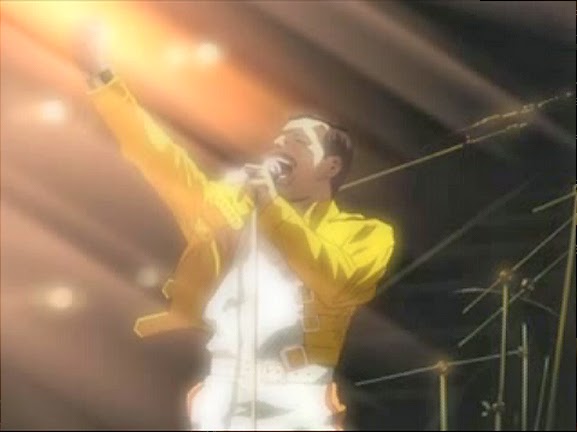
Little did I realize at the time that “Cromartie High School,” actually had Freddie Mercury as a reoccurring character throughout the show. I have never seen “Cromartie High School” and while it does look terrible I have to admit I really like the idea of Freddie Mercury as an anime character.


Freddie Mercury as an anime character. It just feels right.
Perhaps the most obvious reference Japan made to Queen was when Enix produced the Super Nintendo role playing strategy game “Ogre Battle: The March of the Black Queen.”

I love “Ogre Battle” for the Super Nintendo. I loved how the units could upgrade their class at certain levels assuming their stats were good enough. They did a really good job of making you care about each individual unit you had and in an army of them. In both games there was a whole bunch of special characters you could convince to join your army if you made the right decisions. How you played the game and who you had in your army determined how the game would play out and what ending you would get. The Super Nintendo was my heyday for playing video games, and while I am not much of a gamer now you should still trust me “Ogre Battle” is awesome. Ironically there are no ogres in the “Ogre Battle.”

“Ogre Battle” the game was released in 1993 and I am kind of ashamed to admit that I did not get the Queen references back then, but in my defence the only Queen songs they played on the radio at that time were “We Will Rock You,” “We are the Champions,” “Killer Queen,” “Bicycle Race,” and “Fat Bottom Girls.” You can imagine my delight upon discovering that one of my favourite games was named after not one, but two, Queen songs. Those two sons are of course “Ogre Battle” and “March of the Black Queen,” both tracks from “Queen II.”

“Queen II” is predictably Queen’s second album. Released in 1974 and immediately following their debut album Queen took a turn to the fantastic. The concept album is the telling of a strange story about the White Queen and the Black Queen where nearly every song blends into the next like one big rock opera. On the original release of the album, the record had the first side dedicated as the white side and the second side dedicated as the black side, a novelty lost to us in our modern digital world. The band wore all white on the white side and all black naturally on the black side in the album art.

The first side, the white side, is playful. The White Queen is depicted as an object of celestial beauty and worthy of her monarchal rule. The White Queen is the good queen of this fantastic tale.

The White Queen (As It Began)

Meanwhile the second side, the black side, is war. It starts with “Ogre Battle” a rather enthusiastic song about war, so much so, I wonder if it is actually about theatre and play, and not a literal battle. The Black Queen described to us in “The March of the Black Queen” is a powerful and terrible ruler, but still a temptress and worthy of our allegiance - “I'll be your bad boy - I'll do the march of the Black Queen.”

The March of The Black Queen

I am no expert in
fashion. That is all.

The theme of black and white goes further still, as Queen began to wear black and white spandex outfits in many of their live performances, including the music video for “Bohemian Rhapsody” where this outlandish clothing is made most famous. It is impossible to ignore the double entendre of a dueling white and black Queen, some strange self insertion of the band’s personification is being done on “Queen II” not entirely dissimilar a concept to the character “Pink Floyd” in Pink Floyd’s “The Wall.” Is Queen the band both a beautiful fair angel and a dark powerful sorcerers? And what does that even mean? Both aspect of Queen are vague enough to mean pretty much anything and both are presented in a rather positive light. In fact both the white queen and the black queen come across as beings of great love and admiration; funny how love is.

Despite being a lesser known album by the hugely successfully band, “Queen II” has had a major artistic ripple throughout Queen’s creative approach, especially during their early years; also it is one of my favorites, partially because of the connection it has to “Ogre Battle” the Super Nintendo game, but also because of the weird fantastic voyage the lyrics and instrumental take us on. It should be noted that Brian May is often overlooked as the truly phenomenal guitar player he is. There are some fantastic tripped out bridges and solos through “Queen II” and “Ogre Battle.” Also the lyrical content is superb, I have spent a lot of time wondering what the two way mirror mountain might be like, twin mirror-mountains with two paths, a mountain that can only be seen from one side, or maybe a mountain made of mirrors.

Then “Queen II” ends with “The Seven Seas of Rhye” which is the most fun a song has ever been. The original self titled Queen album ended with “The Seven Seas of Rhye” but that version is an instrumental, “Queen II”’s version has lyrics which makes it a superior drinking song, and you cannot have a song metaphorically reference seas made of liquor without it naturally becoming a great drinking song.

The Seven Seas of Rhye

Queen Endora is the Black Queen
in Ogre Battle.  Nice pants.
I could make an effort to imagine exactly what sort of fantasy adventure is going on in “Queen II” but, others have already done a much better job of conjuring up an explanation than I could: http://home.netcom.com/~zmoq/pages/queenii.htm, the land of Rhye? That’s awesome. However I like to believe the story of “Queen II” is exactly like the video game “Ogre Battle,” just because. There are dragons and sky knights and it is so much fun when your knights and valkyries hit level fifteen and you can turn them into paladins and muses.

There was a second ogre battle games for the Nintendo 64 titled “Ogre Battle 64 – Person of Lordly Caliber.” I am worried to admit that if “person of lordly caliber” is a Queen reference, I do not know it. “Ogre Battle 64” was also a great game they fixed a few things that were not perfect about the original, also you get to battle ogres this time around.

I really, really like “Ogre Battle” the song and all of "Queen II," it is just such a wonderfully strange song and album, and as far as I can reason the rest of Queen’s musical career, and the video game of the same name, are the logical conclusion. Majestic and outlandish “Ogre Battle” and the white and black queens set a path of adventure and spandex for one of Britain’s greatest rock bands ever, and of course Japan loved it.

Until next month, keep on rocking in the free world.

- King of Braves

Saturday, March 8, 2014

Queen - Bohemian Rhapsody


I am old enough to remember Freddie Mercury’s death. I would have been eight years old at the time and I had no idea what being gay meant or that Freddie Mercury was the Emperor of gay people. All I knew at the time was that the really cool dude who sang “We Will Rock You” and “We are the Champions” was dead, and it was sad.

It is claimed that Mercury’s death had a powerful effect on record sales, as is often the case with post-mortem success. It has been estimated that Queen’s albums have sold more copies in the past twenty years than they ever did during Freddie’s life, though that could easily be explained by a new generation discovering Queen and global population growth. For me the impact of Freddie’s death meant something more meaningful. I was once in a dialogue with someone about mentally strong people in music and the first person that came to mind for me was Freddie Mercury. Here was this flamboyantly gay man fearlessly leading an eccentric rock band with such supreme confidence that he was able to commanded great respect from everyone, including homophobes. More than that even, he was dying of aids for a long time and he never said anything, he never let on that he was in pain. It takes a very strong person to limp towards death and never utter a complaint or even let it show. He died bravely and I really respect Freddie Mercury for that.

Something else interesting happened around that time. The sudden explosion in Queen’s new found popularity caused a shift in the specifics surrounding Queen’s popularity. What I mean by that last cryptic sentence is that “Bohemian Rhapsody” grew in international appeal more so than any other Queen song. When I was a child the only Queen songs I ever heard on the radio were “Bicycle Race,” “Killer Queen,” “Fat Bottom Girls,” “We Will Rock You” and “We are the Champions.” “We are the Champions” was always played at the end of every Stanley Cup final winning game, so I was quite familiar with it. So sometime during the nineties “Bohemian Rhapsody” overtook every other Queen song as the general consensus epoch of the group.

I sometimes wonder if this scene from the movie “Wayne’s World” might have something to do with it;

“Bohemian Rhapsody” is a six minute wild ride. It is a leaping song of highs, lows and odd turns, both in style and delivery. It is no surprise why everyone loves it so, but what does “Bohemian Rhapsody” mean?

Bohemian:

- A native or inhabitant of Bohemia. (The Kingdom of Bohemia currently resides within the borders of the Czech Republic)

- A person who has informal and unconventional social habits (artist or writer)

Rhapsody:

- An effusively enthusiastic or ecstatic expression of feeling.

- An epic poem; or part of it, of a suitable length for recitation at one time.

Bohemian Rhapsody:

- An epic song by Queen, possibly about an unconventional person who may or may not have been Czech?

I think it is safe to say that Freddie Mercury was himself an informal, unconventional person, and I also think it is safe to extend these qualities to the “poor boy” in “Bohemian Rhapsody.” Furthermore it is fair to presume the rhapsody part of the song is purely musical pronouncement, however... I wonder if there is a deliberate connection to Franz Liszt “Hungarian Rhapsody.”

What you never heard of Franz Liszt or “Hungarian Rhapsody?” Don’t fret, that’s why the Music In Review exists.

The “Hungarian Rhapsodies” is a nineteen set piano piece of classic music themed around Hungarian folk lore. While many of the songs within the “Hungarian Rhapsodies” were written by upper class Hungarian peoples, Liszt added a strong touch of dance qualities to the piano’s sound and mixed in the flavour of gypsy stylization of the time, which consisted mostly of improvisation that included jumps in tempo from slow to fast. Almost like a poor boy showing up to a rich gala or opera and shaking everything up.

“Hungarian Rhopsody no.2” is the most famous of the nineteen piece set;

Hungarian Rhapsody

Perhaps there is a greater connection between “Bohemian Rhapsody” and “Hungarian Rhapsody” than I know. I do not know enough about Hungarian folk lore or the stories being represented by Liszt in “Hungarian Rhapsody” so I cannot make a connection in story between the piano concertos and Queen’s rock and roll masterpiece. However I think there is something to the similarity in names, after all the kingdom of Bohemian is not geographically very far from Hungary, and it is not as though there are a great many song titles out there containing the word rhapsody in relation to a central European kingdom. I believe there is a connection between the two pieces of music but it does not really clear up the mystery of “Bohemian Rhapsody.”

A lot of my friends on Facebook.com keep posting memes about how great Freddie Mercury, Queen, and “Bohemian Rhapsody” are and rightfully so. Among them was this image;

“...it’s the story of a boy whose girlfriend left him for some other guy. He kills him, now the gang of that guy is looking for him. He goes to say goodbye to his mother before the gang finds him. The ‘opera’ part is the gunfight, where the gang mocks him for being a ‘just a poor boy.’”

“They shot in the air, which is the thunderbolt and lightning. He begs, but they won’t let him go. So he kills them all. ‘So you think you can stone me and spit in my eye?’ as he celebrates.”

“But still, he knows he’ll have to spend his life as a fugitive. He needs to ‘get right out of here,’ which explains the melancholy at the end. Even though he came out alive, he’ll never see his mother again.
”

That is a good theory about “Bohemian Rhapsody,” but I am not convinced it is altogether accurate. I think we can all agree the catalyst of the story resides within the murder of a man. The narrator is the most likely guilty culprit as he confesses the crime to his mother;

“Mama, just killed a man,
Put a gun against his head,
Pulled my trigger, now he's dead.”


And laments the actions;

“Mama, life had just begun,
But now I've gone and thrown it all away.”


I have always interpreted the main body of “Bohemian Rhapsody” as the trial of this young man who has committed murder. The accused is “just a boy poor” and struggles to defend himself because he is overcome with guilt, which he expressed earlier in the song to his mother, and also perhaps because he is “poor” and unable to stand up to the heavy hammer of the law or a legal system that has always favored the rich, and the plaintiff openly mock him;

“I see a little silhouetto of a man,
Scaramouch, scaramouch will you do the fandango,
Thunderbolt and lightning very very frightening me.”


I had always interpreted the “thunderbolt and lighting” as the sound of the judge’s gavel crushing down dramatically spelling the end of the trial and the doom of our protagonist.

First our protagonist pleads for mercy;

“But I'm just a poor boy and nobody loves me.”

And finds some support;

“He's just a poor boy from a poor family,
Spare him his life from this monstrosity.”


The debate rages on and eventually “the poor boy” loses his temper and shouts at his accusers in one last desperate effort to fight for his freedom,

“So you think you can stone me and spit in my eye.
So you think you can love me and leave me to die.
Oh baby can't do this to me baby.
Just gotta get out just gotta get right outta here.”


And at last he accepts his fate, because “nothing really matters.”

That is what I always thought was going on, but I want to know what you think.

We may never know exactly what was going on in Freddie Mercury’s mind when he wrote “Bohemian Rhapsody.” Mercury was a strange animal and part of his mystique was his outlandish style and how it melded with his tremendous imagination and this only adds to the mystery of “Bohemian Rhapsody” because any theory, no matter how informal or unconventional is potentially accurate, as suggested by Mercury and his very deliberate choice of title for this epic poem.

- King of Braves

Monday, February 24, 2014

The Feelers - Fishing for Lisa


In August of 2007 I talked about my favorite Feelers song “Pressure Man.” “Pressure Man” was the first track off of The Feelers’ first album “Supersystem” (1998), so looking back it was a logical launching point for an introduction to the band. I feel it has been long enough to talk about The Feelers again.

The Feelers - "Pressure Man" http://colinkellymusicinreview.blogspot.ca/2011/03/august-2007-feelers-pressure-man.html

For those who do not know, The Feelers are a New Zealand rock band that debuted in 1990 and while their international success is very limited they just might be the most successful local rock band ever produced by New Zealand. The point is The Feelers are a really good rock band and basically no one knows who they are outside of New Zealand except me. Well if “Pressure Man” and my obscurity failed to convince anyone to give The Feelers a fair listen then maybe an additional six and a half years of Music In Review and “Fishing for Lisa” will.

“Fishing for Lisa” is a rock ballad off of The Feelers’ second album “Communicate,” (2001) and I believe it is one of the most powerful ballads about heart break ever. The story is more or less the same as any story of heart break, he used to have her and now she’s gone.

“I'm trying to find my angel,
You give nothing, get the same returned.
I said it would be this hard,
Well if you want it, when you going to learn.”

From the lyrics we can infer this specific ballad to also include certain additional complications of trying to get Lisa back and also I think there is a new lover involved;

“When are you going to wake up?
When are you going to want what's in your face?
When are you going to give up?
Cause when you do I'm going to take your place.”

I do not know, but I always thought the last line there should be “take his place.” As in Lisa had moved on to someone else and our Feelers’ front man James Reid is declaring his rightful place by her side, waiting for her to leave that new guy and return to him.

Also there is child somewhere in the mix;

“I'm fishing for Lisa,
Like a meeting in the water, lost.
You should've know better,
Than a lecture at your daughter’s cost.”

“A lecture at your daughter’s cost,” fills the mind with all sorts of worrisome trouble.

That is the verses for “Fishing for Lisa,” pretty decent lyrics all in all, a strong sense of poetry throughout. “Fishing for Lisa” would stand out as a far above average song of heartbreak and longing if we left it at this, however the real punch in the gut that stays with us forever is the chorus.

“I thought you're my reason to live...
I thought you're my reason to live....”

That pretty much says it all right there does it not? Real passion for a relationship could not be further pronounced or exaggerated than this simple honest sentence, “I thought you were my reason to live.” Some people, the true romantics, the melodramatics, and others, sometimes invest so much of themselves in the person they love they lose sight of themselves. Every brick in the building of James Reid’s narrative character in “Fishing for Lisa” is built upon the foundation of her, Lisa. Without her, there is nothing to build upon, no way up, nothing, and no reason to live.

I think every song about heart break, all the ones that came before and all the ones that came since “Fishing for Lisa” were all of them trying to be “Fishing for Lisa.” The most powerful lyrics ever said on the topic never quite reached this perfect pinnacle. It is such a short and simple summary of every broken heart ever, “I thought you’re my reason to live.”

“Fishing for Lisa” is a sad song I suppose, but there is beauty in the twilight of a ruined heart, something dark and deep we all have felt, a horrible thought we have all at one time crossed and with any strength, hopefully forgot. Sometimes emotions can be so powerful they send us veering into unexpected directions both sorrowful and stupendous.

Until next month, keep on rocking in the free world.

- King of Braves

Sunday, February 16, 2014

The 69 Eyes - Lost Without Love


Love Metal is a sub genre invented by Ville Valo and his band HIM. HIM for the most part has had a monopoly on the genre they invented but not quite entirely. Fellow Finish metal band The 69 Eyes have something a similar sound to HIM and seemingly fit into the ultra specific subgenre of love metal quite nicely.

As stated a moment ago The 69 Eyes are from Finland and formed in 1989 which is interesting to me because this means The 69 Eyes formed before HIM who I would have thought inspired them. This is additional interesting because the gothic dark metal sound of modern day 69 Eyes is nothing like their original 1989 sound which is much more like hair metal. Twenty-five years is a long time and change can be the key to success and in the case of The 69 Eyes their gradual metamorphism into one of the premiere goth/love metal bands of the world might prove to be the key to their legacy in metal.

The 69 Eyes self identify as “dark metal” but whatever, “words.”

On a quick side note it is rather charming that the line up of The 69 Eyes has only experienced one change in their twenty-five years together.  Singer Jyrki 69, bass player Archzie, and guitarist Timo-Timo and Bazie have been part of The 69 Eyes this whole time and in 1992 the original drummer was replaced with Jussi 69.  None of those are their real names and I do not believe Jyrki and Jussi are actual brothers.  The point is way to keep the dream alive 69 Eyes.

So I guess The 69 Eyes were not inspired by HIM. Still I feel the HIM 69 Eyes comparison fairly apt. The first 69 Eyes song I fell in love with was “Still Waters Run Deep” and I very nearly mistook it as a HIM track and I was not the only one.

Still Waters Run Deep

Furthermore Ville Valo has had some influence on The 69 Eyes. Ville has guest sang “Wasting the Dawn” and also “Beneath the Blue,” which indicates to me they are at least friends and why not they are both awesome rock stars living in Finland. “Wasting the Dawn” could have been a HIM song as far as I am concerned.

Wasting The Dawn

So I basically feel justified in saying The 69 Eyes are HIM’s best compatriot in the sub genre love metal.

Now enter modern day.

It is always something special when a band that has been around for over a decade can prove they still got it and The 69 Eyes still got it, which is something of a reoccurring topic on the Music In Review. In 2013 The 69 Eyes released their new single with Nuclear Blast Records “Lost Without Love,” and it is easily one of their best songs ever.

“Lost Without Love” is a fairly straight forward song, from the title alone you know what it is about. The lyrics are simple but rich. The atmosphere is dark but energetic. The message is obvious but powerful. A nice, tight, catchy love ballad, rock song. A perfect example of what love metal is all about and a great showing of creativity and quality production even after twenty-five years of hard work.

I was waiting for the studio album to come out that contains “Lost Without Love” only to realize just recently there is no studio album coming. Instead The 69 Eyes released a new compilation album “The Best of Helsinki Vampires” in Halloween of 2013. “The Best of Helsinki Vampires” is a double album consisting of The 69 Eyes greatest hits, which for some reason is missing “Still Waters Run Deep,” and the only original track is “Lost Without Love,” which is incentive enough for me to pick it up.

When I look past over 2013 I feel that “Lost Without Love” is one of the best songs of that year.  Also when I look over my music collection, bands like Nightwish, HIM, and The 69 Eyes strongly suggest that Finland kind of kicks ass.

- King of Braves

Saturday, January 11, 2014

MC Chris and the Star Wars Bounty Hunters

Fett's Vette

MC Chris, born Christopher Brendan Ward, is a “nerdcore” rapper, and I hesitate to say he is the only one, but certainly he is one of the first. As a nerd MC Chris has gravitated towards job opportunities other musicians might not think to employ, of course I am referring to his many appearances on Cartoon Network’s, Adult Swim. MC did the voice of Hesh on “Sealab 2021” and MC Pee Pants on “Aqua Teen Hunger Force” among other voices on other shows. Both “Sealab 2021” and “Aqua Teen Hunger Force” are too strange to properly explain in passing and both characters add an additional level of complication I do not have time to properly elaborate on, needless to say MC Chris is a special sort of nerd for appearing on these shows and like many people “Sealab 2021” and “Aqua Teen Hunger Force” was my first exposure to MC’s voice, and in turn my first exposure to his music was the episode of “Sealab 2021” where the closing credits were accompanied by that song about the bounty hunter from Star Wars.

MC’s first big break was the big success of “Fett’s Vette” a rap song about the Star War’s bounty hunter Bobba Fett, who according to the song’s lyrics is bounty hunting to pay for a corvette. I am aware that a classy vehicle like a corvette can be expensive but somehow I suspect a star ship like Slave 1 just might cost more, but then again what do any of us know about the intergalactic economy of the Star Wars universe? “Fett’s Vette” appeared on MC’s first studio album “Life’s a Bitch and I’m her Pimp” which came out in 2001, it was a self produced album, half of which was composed of comedy skits, most of which contained self degrading humour.

“Fett’s Vette” became really, really popular. The Internet just ate it up. Behold:


Someone customized their alternator Autobot Tracks (who turns into a corvette) into Bobba Fett... makes sense.
And the winner for the most dedicated nerd, this guy.
As mentioned, MC Chris is a comedian of sorts and likes to have skits on his albums often including fictional conversations with his manager Mr. Chandler (at least I hope their fictional), who berets MC for making terrible albums, and, ironically, terrible skits. The popularity of “Fett’s Vette” overshadowed everything else MC did, so three albums later on his 2006 album “Dungeon Master of Ceremonies” he included a skit where his manager Mr. Chandler gives him a hard time about it. What was Mr. Chandler’s advice? MC should make more songs about Star Wars bounty hunters.


MC Chris being a slave to his own sense of humour ultimately wrote and recorded every single awful suggestion Mr. Chandler made regarding the Star Wars bounty hunters; much the way he eventually recorded the terrible song suggestion “Smackababy” that a homeless man recommended to him in a skit of the same name. In case you could not guess for yourself “Smackababy” is a song about smacking babies.

He never released cassette tapes.

In 2009 on the LPs “Part 6” volumes one through three, one at a time, “IG-88’s 57 Chevy,” “Zuckuss’ Prius” and “Dengar’s Dumptruck,” were released.

IG-88's 57 Chevy
IG-88 gets a fun animated video.

Zuckuss' Prus

Dengar's Dumptruck

Of course as per Mr. Chandler’s instructions we still need Bossk on a segway, or as he so eloquently put it, “put him on a goddamn segway already!”


So in 2010 on MC Chris’s sixth studio album “MC Chris Goes to Hell,” “Bossk on a Segway” was released, along with the final cut versions of “IG-88’s 57 Chevy” and “Dengar’s Dumptruck.”

Bossk on a Segway

IG-88's 57 Chevy (MC Chris Goes to Hell Version)

Dengar's Dumptruck (MC Chris Goes to Hell Version)

And after all that, Mr. Chandler hated it, also he’s a zombie now.


There is one more Star Wars related song by MC Chris, I mean of course there is right? “Han Solo” about the roguish space cowboy we all love. The song “Han Solo” is a parody of Jason Derulo’s “Ridin’ Solo.”

Han Solo

I should call it quits here, but in the effort of being thorough let’s talk about “Apple Tummy” and “Apple Lung.”

In 2009, MC Chris released a remix album “Apple Tummy” which contained reconstructions of some of his most popular songs, which of course had to include his most famous song “Fett’s Vette.” In this version MC’s rapping is played over top of the John Williams’ “Duel of Fates.” This version feels very appropriate, probably because “Duel of Fates” appearance on the original Star Wars trilogy.

Fett's Vette (Apple Tummy Remix)

In 2012, MC Chris released yet another remix album titled “Apple Lung.” This album was produced I believe primarily so parody songs like “Han Solo” and “I Heart Drugs” would finally have an official studio release, but it also included several of MC’s most popular songs redone with various popular samples from music history.

The “Apple Lung” version of “IG-88’s 57 Chevy” includes samples from Styx’s “Mr. Roboto,” Nine Inch Nails’ “The Perfect Drug” and “Closer,” The Prodigy’s “Firestarter” and The Eagles’ “Hotel Colifornia.”

IG-88's 57 Chevy (Apple Lung Remix)

While the “Apple Lung” version of “Fett’s Vette” includes samples from Lit’s “My Own Worst Enemy” and Sum 41’s “Fat Lip.”

Fett's Vette (Apple Lung Remix)

So that is the story of MC Chris and the Star Wars bounty hunters, because nerds and Mr. Chandler weren’t content with Bobba Fett driving a corvette.  I learned a lot from these songs, like I had no idea Dengar had a machine brain.

Until next month, keep on rocking in the free world.

- King of Braves
Because these guys needed a rap anthology.